
Creating Bounding boxes and circles for contours#
Goal#
In this tutorial you will learn how to:
Use the OpenCV function cv::boundingRect
Use the OpenCV function cv::minEnclosingCircle
Theory#
Code#
This tutorial code’s is shown lines below. You can also download it from here
#include "opencv2/imgcodecs.hpp"
#include "opencv2/highgui.hpp"
#include "opencv2/geometry.hpp"
#include "opencv2/imgproc.hpp"
#include <iostream>

using namespace cv;
using namespace std;

Mat src_gray;
int thresh = 100;
RNG rng(12345);

/// Function header
void thresh_callback(int, void* );

int main( int argc, char** argv )
{
    /// Load source image
    CommandLineParser parser( argc, argv, "{@input | stuff.jpg | input image}" );
    Mat src = imread( samples::findFile( parser.get<String>( "@input" ) ) );
    if( src.empty() )
    {
        cout << "Could not open or find the image!\n" << endl;
        cout << "usage: " << argv[0] << " <Input image>" << endl;
        return -1;
    }

    /// Convert image to gray and blur it
    cvtColor( src, src_gray, COLOR_BGR2GRAY );
    blur( src_gray, src_gray, Size(3,3) );

    /// Create Window
    const char* source_window = "Source";
    namedWindow( source_window );
    imshow( source_window, src );

    const int max_thresh = 255;
    createTrackbar( "Canny thresh:", source_window, &thresh, max_thresh, thresh_callback );
    thresh_callback( 0, 0 );

    waitKey();
    return 0;
}

void thresh_callback(int, void* )
{
    /// Detect edges using Canny
    Mat canny_output;
    Canny( src_gray, canny_output, thresh, thresh*2 );

    /// Find contours
    vector<vector<Point> > contours;
    findContours( canny_output, contours, RETR_TREE, CHAIN_APPROX_SIMPLE );

    /// Approximate contours to polygons + get bounding rects and circles
    vector<vector<Point> > contours_poly( contours.size() );
    vector<Rect> boundRect( contours.size() );
    vector<Point2f>centers( contours.size() );
    vector<float>radius( contours.size() );

    for( size_t i = 0; i < contours.size(); i++ )
    {
        approxPolyDP( contours[i], contours_poly[i], 3, true );
        boundRect[i] = boundingRect( contours_poly[i] );
        minEnclosingCircle( contours_poly[i], centers[i], radius[i] );
    }

    Mat drawing = Mat::zeros( canny_output.size(), CV_8UC3 );

    /// Draw polygonal contour + bonding rects + circles
    for( size_t i = 0; i< contours.size(); i++ )
    {
        Scalar color = Scalar( rng.uniform(0, 256), rng.uniform(0,256), rng.uniform(0,256) );
        drawContours( drawing, contours_poly, (int)i, color );
        rectangle( drawing, boundRect[i].tl(), boundRect[i].br(), color, 2 );
        circle( drawing, centers[i], (int)radius[i], color, 2 );
    }

    /// Show in a window
    imshow( "Contours", drawing );
}
This tutorial code’s is shown lines below. You can also download it from here
import java.awt.BorderLayout;
import java.awt.Container;
import java.awt.Image;
import java.util.ArrayList;
import java.util.List;
import java.util.Random;

import javax.swing.BoxLayout;
import javax.swing.ImageIcon;
import javax.swing.JFrame;
import javax.swing.JLabel;
import javax.swing.JPanel;
import javax.swing.JSlider;
import javax.swing.event.ChangeEvent;
import javax.swing.event.ChangeListener;

import org.opencv.core.Core;
import org.opencv.core.CvType;
import org.opencv.core.Mat;
import org.opencv.core.MatOfPoint;
import org.opencv.core.MatOfPoint2f;
import org.opencv.core.Point;
import org.opencv.core.Rect;
import org.opencv.core.Scalar;
import org.opencv.core.Size;
import org.opencv.highgui.HighGui;
import org.opencv.imgcodecs.Imgcodecs;
import org.opencv.imgproc.Imgproc;

class GeneralContours1 {
    private Mat srcGray = new Mat();
    private JFrame frame;
    private JLabel imgSrcLabel;
    private JLabel imgContoursLabel;
    private static final int MAX_THRESHOLD = 255;
    private int threshold = 100;
    private Random rng = new Random(12345);

    public GeneralContours1(String[] args) {
        /// Load source image
        String filename = args.length > 0 ? args[0] : "../data/stuff.jpg";
        Mat src = Imgcodecs.imread(filename);
        if (src.empty()) {
            System.err.println("Cannot read image: " + filename);
            System.exit(0);
        }

        /// Convert image to gray and blur it
        Imgproc.cvtColor(src, srcGray, Imgproc.COLOR_BGR2GRAY);
        Imgproc.blur(srcGray, srcGray, new Size(3, 3));

        // Create and set up the window.
        frame = new JFrame("Creating Bounding boxes and circles for contours demo");
        frame.setDefaultCloseOperation(JFrame.EXIT_ON_CLOSE);
        // Set up the content pane.
        Image img = HighGui.toBufferedImage(src);
        addComponentsToPane(frame.getContentPane(), img);
        // Use the content pane's default BorderLayout. No need for
        // setLayout(new BorderLayout());
        // Display the window.
        frame.pack();
        frame.setVisible(true);
        update();
    }

    private void addComponentsToPane(Container pane, Image img) {
        if (!(pane.getLayout() instanceof BorderLayout)) {
            pane.add(new JLabel("Container doesn't use BorderLayout!"));
            return;
        }

        JPanel sliderPanel = new JPanel();
        sliderPanel.setLayout(new BoxLayout(sliderPanel, BoxLayout.PAGE_AXIS));

        sliderPanel.add(new JLabel("Canny threshold: "));
        JSlider slider = new JSlider(0, MAX_THRESHOLD, threshold);
        slider.setMajorTickSpacing(20);
        slider.setMinorTickSpacing(10);
        slider.setPaintTicks(true);
        slider.setPaintLabels(true);
        slider.addChangeListener(new ChangeListener() {
            @Override
            public void stateChanged(ChangeEvent e) {
                JSlider source = (JSlider) e.getSource();
                threshold = source.getValue();
                update();
            }
        });
        sliderPanel.add(slider);
        pane.add(sliderPanel, BorderLayout.PAGE_START);

        JPanel imgPanel = new JPanel();
        imgSrcLabel = new JLabel(new ImageIcon(img));
        imgPanel.add(imgSrcLabel);

        Mat blackImg = Mat.zeros(srcGray.size(), CvType.CV_8U);
        imgContoursLabel = new JLabel(new ImageIcon(HighGui.toBufferedImage(blackImg)));
        imgPanel.add(imgContoursLabel);

        pane.add(imgPanel, BorderLayout.CENTER);
    }

    private void update() {
        /// Detect edges using Canny
        Mat cannyOutput = new Mat();
        Imgproc.Canny(srcGray, cannyOutput, threshold, threshold * 2);

        /// Find contours
        List<MatOfPoint> contours = new ArrayList<>();
        Mat hierarchy = new Mat();
        Imgproc.findContours(cannyOutput, contours, hierarchy, Imgproc.RETR_TREE, Imgproc.CHAIN_APPROX_SIMPLE);

        /// Approximate contours to polygons + get bounding rects and circles
        MatOfPoint2f[] contoursPoly  = new MatOfPoint2f[contours.size()];
        Rect[] boundRect = new Rect[contours.size()];
        Point[] centers = new Point[contours.size()];
        float[][] radius = new float[contours.size()][1];

        for (int i = 0; i < contours.size(); i++) {
            contoursPoly[i] = new MatOfPoint2f();
            Imgproc.approxPolyDP(new MatOfPoint2f(contours.get(i).toArray()), contoursPoly[i], 3, true);
            boundRect[i] = Imgproc.boundingRect(new MatOfPoint(contoursPoly[i].toArray()));
            centers[i] = new Point();
            Imgproc.minEnclosingCircle(contoursPoly[i], centers[i], radius[i]);
        }

        Mat drawing = Mat.zeros(cannyOutput.size(), CvType.CV_8UC3);
        /// Draw polygonal contour + bonding rects + circles
        List<MatOfPoint> contoursPolyList = new ArrayList<>(contoursPoly.length);
        for (MatOfPoint2f poly : contoursPoly) {
            contoursPolyList.add(new MatOfPoint(poly.toArray()));
        }

        for (int i = 0; i < contours.size(); i++) {
            Scalar color = new Scalar(rng.nextInt(256), rng.nextInt(256), rng.nextInt(256));
            Imgproc.drawContours(drawing, contoursPolyList, i, color);
            Imgproc.rectangle(drawing, boundRect[i].tl(), boundRect[i].br(), color, 2);
            Imgproc.circle(drawing, centers[i], (int) radius[i][0], color, 2);
        }

        /// Show in a window
        imgContoursLabel.setIcon(new ImageIcon(HighGui.toBufferedImage(drawing)));
        frame.repaint();
    }
}

public class GeneralContoursDemo1 {
    public static void main(String[] args) {
        // Load the native OpenCV library
        System.loadLibrary(Core.NATIVE_LIBRARY_NAME);

        // Schedule a job for the event dispatch thread:
        // creating and showing this application's GUI.
        javax.swing.SwingUtilities.invokeLater(new Runnable() {
            @Override
            public void run() {
                new GeneralContours1(args);
            }
        });
    }
}
This tutorial code’s is shown lines below. You can also download it from here
from __future__ import print_function
import cv2 as cv
import numpy as np
import argparse
import random as rng

rng.seed(12345)

def thresh_callback(val):
    threshold = val

    # Detect edges using Canny
    canny_output = cv.Canny(src_gray, threshold, threshold * 2)

    # Find contours
    contours, _ = cv.findContours(canny_output, cv.RETR_TREE, cv.CHAIN_APPROX_SIMPLE)

    # Approximate contours to polygons + get bounding rects and circles
    contours_poly = [None]*len(contours)
    boundRect = [None]*len(contours)
    centers = [None]*len(contours)
    radius = [None]*len(contours)
    for i, c in enumerate(contours):
        contours_poly[i] = cv.approxPolyDP(c, 3, True)
        boundRect[i] = cv.boundingRect(contours_poly[i])
        centers[i], radius[i] = cv.minEnclosingCircle(contours_poly[i])

    drawing = np.zeros((canny_output.shape[0], canny_output.shape[1], 3), dtype=np.uint8)

    # Draw polygonal contour + bonding rects + circles
    for i in range(len(contours)):
        color = (rng.randint(0,256), rng.randint(0,256), rng.randint(0,256))
        cv.drawContours(drawing, contours_poly, i, color)
        cv.rectangle(drawing, (int(boundRect[i][0]), int(boundRect[i][1])), \
          (int(boundRect[i][0]+boundRect[i][2]), int(boundRect[i][1]+boundRect[i][3])), color, 2)
        cv.circle(drawing, (int(centers[i][0]), int(centers[i][1])), int(radius[i]), color, 2)

    # Show in a window
    cv.imshow('Contours', drawing)

# Load source image
parser = argparse.ArgumentParser(description='Code for Creating Bounding boxes and circles for contours tutorial.')
parser.add_argument('--input', help='Path to input image.', default='stuff.jpg')
args = parser.parse_args()

src = cv.imread(cv.samples.findFile(args.input))
if src is None:
    print('Could not open or find the image:', args.input)
    exit(0)

# Convert image to gray and blur it
src_gray = cv.cvtColor(src, cv.COLOR_BGR2GRAY)
src_gray = cv.blur(src_gray, (3,3))

# Create Window
source_window = 'Source'
cv.namedWindow(source_window)
cv.imshow(source_window, src)
max_thresh = 255
thresh = 100 # initial threshold
cv.createTrackbar('Canny thresh:', source_window, thresh, max_thresh, thresh_callback)
thresh_callback(thresh)

cv.waitKey()
Explanation#
The main function is rather simple, as follows from the comments we do the following:
Open the image, convert it into grayscale and blur it to get rid of the noise.
/// Load source image
CommandLineParser parser( argc, argv, "{@input | stuff.jpg | input image}" );
Mat src = imread( samples::findFile( parser.get<String>( "@input" ) ) );
if( src.empty() )
{
    cout << "Could not open or find the image!\n" << endl;
    cout << "usage: " << argv[0] << " <Input image>" << endl;
    return -1;
}

/// Convert image to gray and blur it
cvtColor( src, src_gray, COLOR_BGR2GRAY );
blur( src_gray, src_gray, Size(3,3) );
/// Load source image
String filename = args.length > 0 ? args[0] : "../data/stuff.jpg";
Mat src = Imgcodecs.imread(filename);
if (src.empty()) {
    System.err.println("Cannot read image: " + filename);
    System.exit(0);
}

/// Convert image to gray and blur it
Imgproc.cvtColor(src, srcGray, Imgproc.COLOR_BGR2GRAY);
Imgproc.blur(srcGray, srcGray, new Size(3, 3));
# Load source image
parser = argparse.ArgumentParser(description='Code for Creating Bounding boxes and circles for contours tutorial.')
parser.add_argument('--input', help='Path to input image.', default='stuff.jpg')
args = parser.parse_args()

src = cv.imread(cv.samples.findFile(args.input))
if src is None:
    print('Could not open or find the image:', args.input)
    exit(0)

# Convert image to gray and blur it
src_gray = cv.cvtColor(src, cv.COLOR_BGR2GRAY)
src_gray = cv.blur(src_gray, (3,3))
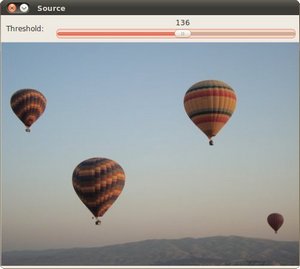
Create a window with header “Source” and display the source file in it.
/// Create Window
const char* source_window = "Source";
namedWindow( source_window );
imshow( source_window, src );
// Create and set up the window.
frame = new JFrame("Creating Bounding boxes and circles for contours demo");
frame.setDefaultCloseOperation(JFrame.EXIT_ON_CLOSE);
// Set up the content pane.
Image img = HighGui.toBufferedImage(src);
addComponentsToPane(frame.getContentPane(), img);
# Create Window
source_window = 'Source'
cv.namedWindow(source_window)
cv.imshow(source_window, src)
Create a trackbar on the
source_windowand assign a callback function to it. In general callback functions are used to react to some kind of signal, in our case it’s trackbar’s state change. Explicit one-time call ofthresh_callbackis necessary to display the “Contours” window simultaneously with the “Source” window.
const int max_thresh = 255;
createTrackbar( "Canny thresh:", source_window, &thresh, max_thresh, thresh_callback );
thresh_callback( 0, 0 );
sliderPanel.add(new JLabel("Canny threshold: "));
JSlider slider = new JSlider(0, MAX_THRESHOLD, threshold);
slider.setMajorTickSpacing(20);
slider.setMinorTickSpacing(10);
slider.setPaintTicks(true);
slider.setPaintLabels(true);
slider.addChangeListener(new ChangeListener() {
    @Override
    public void stateChanged(ChangeEvent e) {
        JSlider source = (JSlider) e.getSource();
        threshold = source.getValue();
        update();
    }
});
max_thresh = 255
thresh = 100 # initial threshold
cv.createTrackbar('Canny thresh:', source_window, thresh, max_thresh, thresh_callback)
thresh_callback(thresh)
The callback function does all the interesting job.
Use cv::Canny to detect edges in the images.
# Detect edges using Canny
canny_output = cv.Canny(src_gray, threshold, threshold * 2)
Finds contours and saves them to the vectors
contourandhierarchy.
/// Find contours
vector<vector<Point> > contours;
findContours( canny_output, contours, RETR_TREE, CHAIN_APPROX_SIMPLE );
# Find contours
contours, _ = cv.findContours(canny_output, cv.RETR_TREE, cv.CHAIN_APPROX_SIMPLE)
For every found contour we now apply approximation to polygons with accuracy +-3 and stating that the curve must be closed. After that we find a bounding rect for every polygon and save it to
boundRect. At last we find a minimum enclosing circle for every polygon and save it tocenterandradiusvectors.
/// Approximate contours to polygons + get bounding rects and circles
vector<vector<Point> > contours_poly( contours.size() );
vector<Rect> boundRect( contours.size() );
vector<Point2f>centers( contours.size() );
vector<float>radius( contours.size() );

for( size_t i = 0; i < contours.size(); i++ )
{
    approxPolyDP( contours[i], contours_poly[i], 3, true );
    boundRect[i] = boundingRect( contours_poly[i] );
    minEnclosingCircle( contours_poly[i], centers[i], radius[i] );
}
/// Approximate contours to polygons + get bounding rects and circles
MatOfPoint2f[] contoursPoly  = new MatOfPoint2f[contours.size()];
Rect[] boundRect = new Rect[contours.size()];
Point[] centers = new Point[contours.size()];
float[][] radius = new float[contours.size()][1];

for (int i = 0; i < contours.size(); i++) {
    contoursPoly[i] = new MatOfPoint2f();
    Imgproc.approxPolyDP(new MatOfPoint2f(contours.get(i).toArray()), contoursPoly[i], 3, true);
    boundRect[i] = Imgproc.boundingRect(new MatOfPoint(contoursPoly[i].toArray()));
    centers[i] = new Point();
    Imgproc.minEnclosingCircle(contoursPoly[i], centers[i], radius[i]);
}
# Approximate contours to polygons + get bounding rects and circles
contours_poly = [None]*len(contours)
boundRect = [None]*len(contours)
centers = [None]*len(contours)
radius = [None]*len(contours)
for i, c in enumerate(contours):
    contours_poly[i] = cv.approxPolyDP(c, 3, True)
    boundRect[i] = cv.boundingRect(contours_poly[i])
    centers[i], radius[i] = cv.minEnclosingCircle(contours_poly[i])
We found everything we need, all we have to do is to draw.
Create new Mat of unsigned 8-bit chars, filled with zeros. It will contain all the drawings we are going to make (rects and circles).
drawing = np.zeros((canny_output.shape[0], canny_output.shape[1], 3), dtype=np.uint8)
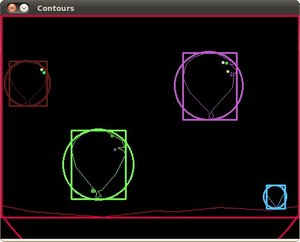
For every contour: pick a random color, draw the contour, the bounding rectangle and the minimal enclosing circle with it.
/// Draw polygonal contour + bonding rects + circles
for( size_t i = 0; i< contours.size(); i++ )
{
    Scalar color = Scalar( rng.uniform(0, 256), rng.uniform(0,256), rng.uniform(0,256) );
    drawContours( drawing, contours_poly, (int)i, color );
    rectangle( drawing, boundRect[i].tl(), boundRect[i].br(), color, 2 );
    circle( drawing, centers[i], (int)radius[i], color, 2 );
}
/// Draw polygonal contour + bonding rects + circles
List<MatOfPoint> contoursPolyList = new ArrayList<>(contoursPoly.length);
for (MatOfPoint2f poly : contoursPoly) {
    contoursPolyList.add(new MatOfPoint(poly.toArray()));
}

for (int i = 0; i < contours.size(); i++) {
    Scalar color = new Scalar(rng.nextInt(256), rng.nextInt(256), rng.nextInt(256));
    Imgproc.drawContours(drawing, contoursPolyList, i, color);
    Imgproc.rectangle(drawing, boundRect[i].tl(), boundRect[i].br(), color, 2);
    Imgproc.circle(drawing, centers[i], (int) radius[i][0], color, 2);
}
# Draw polygonal contour + bonding rects + circles
for i in range(len(contours)):
    color = (rng.randint(0,256), rng.randint(0,256), rng.randint(0,256))
    cv.drawContours(drawing, contours_poly, i, color)
    cv.rectangle(drawing, (int(boundRect[i][0]), int(boundRect[i][1])), \
      (int(boundRect[i][0]+boundRect[i][2]), int(boundRect[i][1]+boundRect[i][3])), color, 2)
    cv.circle(drawing, (int(centers[i][0]), int(centers[i][1])), int(radius[i]), color, 2)
Display the results: create a new window “Contours” and show everything we added to drawings on it.
Result#
Here it is: