
Template Matching#
Goal#
In this tutorial you will learn how to:
Use the OpenCV function matchTemplate() to search for matches between an image patch and an input image
Use the OpenCV function minMaxLoc() to find the maximum and minimum values (as well as their positions) in a given array.
Theory#
What is template matching?#
Template matching is a technique for finding areas of an image that match (are similar) to a template image (patch).
While the patch must be a rectangle it may be that not all of the rectangle is relevant. In such a case, a mask can be used to isolate the portion of the patch that should be used to find the match.
How does it work?#
We need two primary components:
Source image (I): The image in which we expect to find a match to the template image
Template image (T): The patch image which will be compared to the source image
our goal is to detect the highest matching area:
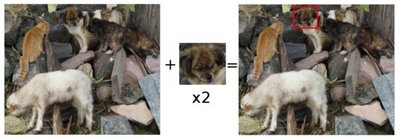
To identify the matching area, we have to compare the template image against the source image by sliding it:
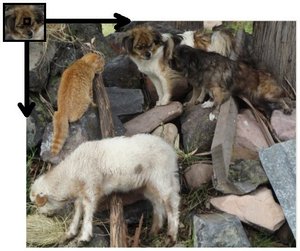
By sliding, we mean moving the patch one pixel at a time (left to right, up to down). At each location, a metric is calculated so it represents how “good” or “bad” the match at that location is (or how similar the patch is to that particular area of the source image).
For each location of T over I, you store the metric in the result matrix R. Each location \((x,y)\) in R contains the match metric:
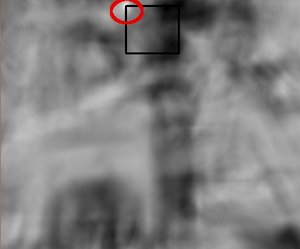
the image above is the result R of sliding the patch with a metric TM_CCORR_NORMED. The brightest locations indicate the highest matches. As you can see, the location marked by the red circle is probably the one with the highest value, so that location (the rectangle formed by that point as a corner and width and height equal to the patch image) is considered the match.
In practice, we locate the highest value (or lower, depending of the type of matching method) in the R matrix, using the function minMaxLoc()
How does the mask work?#
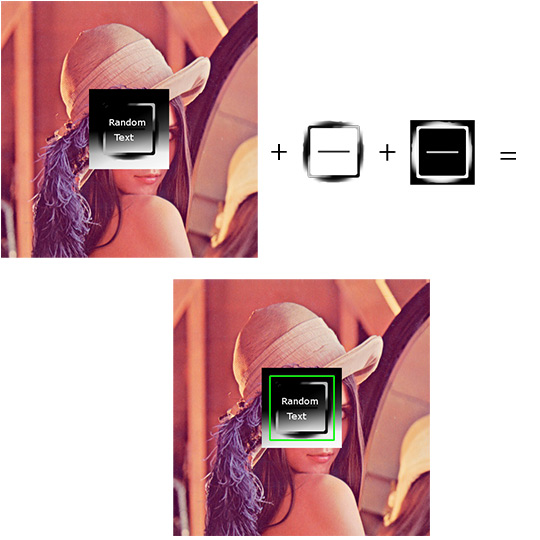
If masking is needed for the match, three components are required:
Source image (I): The image in which we expect to find a match to the template image
Template image (T): The patch image which will be compared to the source image
Mask image (M): The mask, a grayscale image that masks the template
Only two matching methods currently accept a mask: TM_SQDIFF and TM_CCORR_NORMED (see below for explanation of all the matching methods available in opencv).
The mask must have the same dimensions as the template
The mask should have a CV_8U or CV_32F depth and the same number of channels as the template image. In CV_8U case, the mask values are treated as binary, i.e. zero and non-zero. In CV_32F case, the values should fall into [0..1] range and the template pixels will be multiplied by the corresponding mask pixel values. Since the input images in the sample have the CV_8UC3 type, the mask is also read as color image.
Which are the matching methods available in OpenCV?#
Good question. OpenCV implements Template matching in the function matchTemplate(). The available methods are 6:
method=TM_SQDIFF
\[ R(x,y)= \sum _{x',y'} (T(x',y')-I(x+x',y+y'))^2 \]method=TM_SQDIFF_NORMED
\[ R(x,y)= \frac{\sum_{x',y'} (T(x',y')-I(x+x',y+y'))^2}{\sqrt{\sum_{x',y'}T(x',y')^2 \cdot \sum_{x',y'} I(x+x',y+y')^2}} \]method=TM_CCORR
\[ R(x,y)= \sum _{x',y'} (T(x',y') \cdot I(x+x',y+y')) \]method=TM_CCORR_NORMED
\[ R(x,y)= \frac{\sum_{x',y'} (T(x',y') \cdot I(x+x',y+y'))}{\sqrt{\sum_{x',y'}T(x',y')^2 \cdot \sum_{x',y'} I(x+x',y+y')^2}} \]method=TM_CCOEFF
\[ R(x,y)= \sum _{x',y'} (T'(x',y') \cdot I'(x+x',y+y')) \]where
\[\begin{split}\begin{array}{l} T'(x',y')=T(x',y') - 1/(w \cdot h) \cdot \sum _{x'',y''} T(x'',y'') \\ I'(x+x',y+y')=I(x+x',y+y') - 1/(w \cdot h) \cdot \sum _{x'',y''} I(x+x'',y+y'') \end{array}\end{split}\]method=TM_CCOEFF_NORMED
\[ R(x,y)= \frac{ \sum_{x',y'} (T'(x',y') \cdot I'(x+x',y+y')) }{ \sqrt{\sum_{x',y'}T'(x',y')^2 \cdot \sum_{x',y'} I'(x+x',y+y')^2} } \]
Code#
What does this program do?
Loads an input image, an image patch (template), and optionally a mask
Perform a template matching procedure by using the OpenCV function matchTemplate() with any of the 6 matching methods described before. The user can choose the method by entering its selection in the Trackbar. If a mask is supplied, it will only be used for the methods that support masking
Normalize the output of the matching procedure
Localize the location with higher matching probability
Draw a rectangle around the area corresponding to the highest match
Downloadable code: Click here
Code at glance:
#include "opencv2/imgcodecs.hpp"
#include "opencv2/highgui.hpp"
#include "opencv2/imgproc.hpp"
#include <iostream>

using namespace std;
using namespace cv;

/// Global Variables
bool use_mask;
Mat img; Mat templ; Mat mask; Mat result;
const char* image_window = "Source Image";
const char* result_window = "Result window";

int match_method;
int max_Trackbar = 5;

/// Function Headers
void MatchingMethod( int, void* );

const char* keys =
"{ help  h| | Print help message. }"
"{ @input1 | Template_Matching_Original_Image.jpg | image_name }"
"{ @input2 | Template_Matching_Template_Image.jpg | template_name }"
"{ @input3 |  | mask_name }";

int main( int argc, char** argv )
{
  CommandLineParser parser( argc, argv, keys );
  samples::addSamplesDataSearchSubDirectory( "doc/tutorials/imgproc/histograms/template_matching/images" );

  /// Load image and template
  img = imread( samples::findFile( parser.get<String>("@input1") ) );
  templ = imread( samples::findFile( parser.get<String>("@input2") ), IMREAD_COLOR );

  if(argc > 3) {
    use_mask = true;
    mask = imread(samples::findFile( parser.get<String>("@input3") ), IMREAD_COLOR );
  }

  if(img.empty() || templ.empty() || (use_mask && mask.empty()))
  {
    cout << "Can't read one of the images" << endl;
    return EXIT_FAILURE;
  }

  /// Create windows
  namedWindow( image_window, WINDOW_AUTOSIZE );
  namedWindow( result_window, WINDOW_AUTOSIZE );

  /// Create Trackbar
  const char* trackbar_label = "Method: \n 0: SQDIFF \n 1: SQDIFF NORMED \n 2: TM CCORR \n 3: TM CCORR NORMED \n 4: TM COEFF \n 5: TM COEFF NORMED";
  createTrackbar( trackbar_label, image_window, &match_method, max_Trackbar, MatchingMethod );

  MatchingMethod( 0, 0 );

  waitKey(0);
  return EXIT_SUCCESS;
}

void MatchingMethod( int, void* )
{
  /// Source image to display
  Mat img_display;
  img.copyTo( img_display );

  /// Create the result matrix
  int result_cols = img.cols - templ.cols + 1;
  int result_rows = img.rows - templ.rows + 1;

  result.create( result_rows, result_cols, CV_32FC1 );

  /// Do the Matching and Normalize
  bool method_accepts_mask = (TM_SQDIFF == match_method || match_method == TM_CCORR_NORMED);
  if (use_mask && method_accepts_mask)
    { matchTemplate( img, templ, result, match_method, mask); }
  else
    { matchTemplate( img, templ, result, match_method); }

  normalize( result, result, 0, 1, NORM_MINMAX, -1, Mat() );

  /// Localizing the best match with minMaxLoc
  double minVal; double maxVal; Point minLoc; Point maxLoc;
  Point matchLoc;

  minMaxLoc( result, &minVal, &maxVal, &minLoc, &maxLoc, Mat() );

  /// For SQDIFF and SQDIFF_NORMED, the best matches are lower values. For all the other methods, the higher the better
  if( match_method  == TM_SQDIFF || match_method == TM_SQDIFF_NORMED )
    { matchLoc = minLoc; }
  else
    { matchLoc = maxLoc; }

  /// Show me what you got
  rectangle( img_display, matchLoc, Point( matchLoc.x + templ.cols , matchLoc.y + templ.rows ), Scalar::all(0), 2, 8, 0 );
  rectangle( result, matchLoc, Point( matchLoc.x + templ.cols , matchLoc.y + templ.rows ), Scalar::all(0), 2, 8, 0 );

  imshow( image_window, img_display );
  imshow( result_window, result );

  return;
}
Downloadable code: Click here
Code at glance:
import java.awt.GridLayout;
import java.awt.Image;
import java.util.Hashtable;

import javax.swing.ImageIcon;
import javax.swing.JFrame;
import javax.swing.JLabel;
import javax.swing.JSlider;
import javax.swing.event.ChangeEvent;
import javax.swing.event.ChangeListener;

import org.opencv.core.Core;
import org.opencv.core.CvType;
import org.opencv.core.Mat;
import org.opencv.core.Point;
import org.opencv.core.Scalar;
import org.opencv.highgui.HighGui;
import org.opencv.imgcodecs.Imgcodecs;
import org.opencv.imgproc.Imgproc;

class MatchTemplateDemoRun implements ChangeListener {

    /// Global Variables
    Boolean use_mask = false;
    Mat img = new Mat(), templ = new Mat();
    Mat mask = new Mat();

    int match_method;

    JLabel imgDisplay = new JLabel(), resultDisplay = new JLabel();

    public void run(String[] args) {
        if (args.length < 2) {
            System.out.println("Not enough parameters");
            System.out.println("Program arguments:\n<image_name> <template_name> [<mask_name>]");
            System.exit(-1);
        }

        /// Load image and template
        img = Imgcodecs.imread(args[0], Imgcodecs.IMREAD_COLOR);
        templ = Imgcodecs.imread(args[1], Imgcodecs.IMREAD_COLOR);

        if (args.length > 2) {
            use_mask = true;
            mask = Imgcodecs.imread(args[2], Imgcodecs.IMREAD_COLOR);
        }

        if (img.empty() || templ.empty() || (use_mask && mask.empty())) {
            System.out.println("Can't read one of the images");
            System.exit(-1);
        }

        matchingMethod();
        createJFrame();
    }

    private void matchingMethod() {
        Mat result = new Mat();

        /// Source image to display
        Mat img_display = new Mat();
        img.copyTo(img_display);

        /// Create the result matrix
        int result_cols = img.cols() - templ.cols() + 1;
        int result_rows = img.rows() - templ.rows() + 1;

        result.create(result_rows, result_cols, CvType.CV_32FC1);

        /// Do the Matching and Normalize
        Boolean method_accepts_mask = (Imgproc.TM_SQDIFF == match_method || match_method == Imgproc.TM_CCORR_NORMED);
        if (use_mask && method_accepts_mask) {
            Imgproc.matchTemplate(img, templ, result, match_method, mask);
        } else {
            Imgproc.matchTemplate(img, templ, result, match_method);
        }

        Core.normalize(result, result, 0, 1, Core.NORM_MINMAX, -1, new Mat());

        /// Localizing the best match with minMaxLoc
        Point matchLoc;

        Core.MinMaxLocResult mmr = Core.minMaxLoc(result);

        /// For SQDIFF and SQDIFF_NORMED, the best matches are lower values.
        /// For all the other methods, the higher the better
        if (match_method == Imgproc.TM_SQDIFF || match_method == Imgproc.TM_SQDIFF_NORMED) {
            matchLoc = mmr.minLoc;
        } else {
            matchLoc = mmr.maxLoc;
        }

        /// Show me what you got
        Imgproc.rectangle(img_display, matchLoc, new Point(matchLoc.x + templ.cols(), matchLoc.y + templ.rows()),
                new Scalar(0, 0, 0), 2, 8, 0);
        Imgproc.rectangle(result, matchLoc, new Point(matchLoc.x + templ.cols(), matchLoc.y + templ.rows()),
                new Scalar(0, 0, 0), 2, 8, 0);

        Image tmpImg = HighGui.toBufferedImage(img_display);
        ImageIcon icon = new ImageIcon(tmpImg);
        imgDisplay.setIcon(icon);

        result.convertTo(result, CvType.CV_8UC1, 255.0);
        tmpImg = HighGui.toBufferedImage(result);
        icon = new ImageIcon(tmpImg);
        resultDisplay.setIcon(icon);
    }

    @Override
    public void stateChanged(ChangeEvent e) {
        JSlider source = (JSlider) e.getSource();
        if (!source.getValueIsAdjusting()) {
            match_method = source.getValue();
            matchingMethod();
        }
    }

    private void createJFrame() {
        String title = "Source image; Control; Result image";
        JFrame frame = new JFrame(title);
        frame.setLayout(new GridLayout(2, 2));
        frame.add(imgDisplay);

        int min = 0, max = 5;
        JSlider slider = new JSlider(JSlider.VERTICAL, min, max, match_method);

        slider.setPaintTicks(true);
        slider.setPaintLabels(true);

        // Set the spacing for the minor tick mark
        slider.setMinorTickSpacing(1);

        // Customizing the labels
        Hashtable<Integer, JLabel> labelTable = new Hashtable<>();
        labelTable.put(new Integer(0), new JLabel("0 - SQDIFF"));
        labelTable.put(new Integer(1), new JLabel("1 - SQDIFF NORMED"));
        labelTable.put(new Integer(2), new JLabel("2 - TM CCORR"));
        labelTable.put(new Integer(3), new JLabel("3 - TM CCORR NORMED"));
        labelTable.put(new Integer(4), new JLabel("4 - TM COEFF"));
        labelTable.put(new Integer(5), new JLabel("5 - TM COEFF NORMED : (Method)"));
        slider.setLabelTable(labelTable);

        slider.addChangeListener(this);

        frame.add(slider);

        frame.add(resultDisplay);
        frame.setDefaultCloseOperation(JFrame.EXIT_ON_CLOSE);
        frame.pack();
        frame.setVisible(true);
    }
}

public class MatchTemplateDemo {
    public static void main(String[] args) {
        // load the native OpenCV library
        System.loadLibrary(Core.NATIVE_LIBRARY_NAME);

        // run code
        new MatchTemplateDemoRun().run(args);
    }
}
Downloadable code: Click here
Code at glance:
from __future__ import print_function
import sys
import cv2 as cv

use_mask = False
img = None
templ = None
mask = None
image_window = "Source Image"
result_window = "Result window"

match_method = 0
max_Trackbar = 5

def main(argv):

    if (len(sys.argv) < 3):
        print('Not enough parameters')
        print('Usage:\nmatch_template_demo.py <image_name> <template_name> [<mask_name>]')
        return -1

    global img
    global templ
    img = cv.imread(sys.argv[1], cv.IMREAD_COLOR)
    templ = cv.imread(sys.argv[2], cv.IMREAD_COLOR)

    if (len(sys.argv) > 3):
        global use_mask
        use_mask = True
        global mask
        mask = cv.imread( sys.argv[3], cv.IMREAD_COLOR )

    if ((img is None) or (templ is None) or (use_mask and (mask is None))):
        print('Can\'t read one of the images')
        return -1

    cv.namedWindow( image_window, cv.WINDOW_AUTOSIZE )
    cv.namedWindow( result_window, cv.WINDOW_AUTOSIZE )

    trackbar_label = 'Method: \n 0: SQDIFF \n 1: SQDIFF NORMED \n 2: TM CCORR \n 3: TM CCORR NORMED \n 4: TM COEFF \n 5: TM COEFF NORMED'
    cv.createTrackbar( trackbar_label, image_window, match_method, max_Trackbar, MatchingMethod )

    MatchingMethod(match_method)

    cv.waitKey(0)
    return 0

def MatchingMethod(param):

    global match_method
    match_method = param

    img_display = img.copy()
    method_accepts_mask = (cv.TM_SQDIFF == match_method or match_method == cv.TM_CCORR_NORMED)
    if (use_mask and method_accepts_mask):
        result = cv.matchTemplate(img, templ, match_method, None, mask)
    else:
        result = cv.matchTemplate(img, templ, match_method)

    cv.normalize( result, result, 0, 1, cv.NORM_MINMAX, -1 )
    _minVal, _maxVal, minLoc, maxLoc = cv.minMaxLoc(result, None)

    if (match_method == cv.TM_SQDIFF or match_method == cv.TM_SQDIFF_NORMED):
        matchLoc = minLoc
    else:
        matchLoc = maxLoc

    cv.rectangle(img_display, matchLoc, (matchLoc[0] + templ.shape[1], matchLoc[1] + templ.shape[0]), (0,0,0), 2, 8, 0 )
    cv.rectangle(result, matchLoc, (matchLoc[0] + templ.shape[1], matchLoc[1] + templ.shape[0]), (0,0,0), 2, 8, 0 )
    cv.imshow(image_window, img_display)
    cv.imshow(result_window, result)
    pass

if __name__ == "__main__":
    main(sys.argv[1:])
Explanation#
Declare some global variables, such as the image, template and result matrices, as well as the match method and the window names:
use_mask = False
img = None
templ = None
mask = None
image_window = "Source Image"
result_window = "Result window"

match_method = 0
max_Trackbar = 5
Load the source image, template, and optionally, if supported for the matching method, a mask:
/// Load image and template
img = imread( samples::findFile( parser.get<String>("@input1") ) );
templ = imread( samples::findFile( parser.get<String>("@input2") ), IMREAD_COLOR );

if(argc > 3) {
  use_mask = true;
  mask = imread(samples::findFile( parser.get<String>("@input3") ), IMREAD_COLOR );
}

if(img.empty() || templ.empty() || (use_mask && mask.empty()))
{
  cout << "Can't read one of the images" << endl;
  return EXIT_FAILURE;
}
/// Load image and template
img = Imgcodecs.imread(args[0], Imgcodecs.IMREAD_COLOR);
templ = Imgcodecs.imread(args[1], Imgcodecs.IMREAD_COLOR);
global img
global templ
img = cv.imread(sys.argv[1], cv.IMREAD_COLOR)
templ = cv.imread(sys.argv[2], cv.IMREAD_COLOR)

if (len(sys.argv) > 3):
    global use_mask
    use_mask = True
    global mask
    mask = cv.imread( sys.argv[3], cv.IMREAD_COLOR )

if ((img is None) or (templ is None) or (use_mask and (mask is None))):
    print('Can\'t read one of the images')
    return -1
Create the Trackbar to enter the kind of matching method to be used. When a change is detected the callback function is called.
/// Create Trackbar
const char* trackbar_label = "Method: \n 0: SQDIFF \n 1: SQDIFF NORMED \n 2: TM CCORR \n 3: TM CCORR NORMED \n 4: TM COEFF \n 5: TM COEFF NORMED";
createTrackbar( trackbar_label, image_window, &match_method, max_Trackbar, MatchingMethod );
int min = 0, max = 5;
JSlider slider = new JSlider(JSlider.VERTICAL, min, max, match_method);
trackbar_label = 'Method: \n 0: SQDIFF \n 1: SQDIFF NORMED \n 2: TM CCORR \n 3: TM CCORR NORMED \n 4: TM COEFF \n 5: TM COEFF NORMED'
cv.createTrackbar( trackbar_label, image_window, match_method, max_Trackbar, MatchingMethod )
Let’s check out the callback function. First, it makes a copy of the source image:
img_display = img.copy()
Perform the template matching operation. The arguments are naturally the input image I, the template T, the result R and the match_method (given by the Trackbar), and optionally the mask image M.
/// Do the Matching and Normalize
bool method_accepts_mask = (TM_SQDIFF == match_method || match_method == TM_CCORR_NORMED);
if (use_mask && method_accepts_mask)
  { matchTemplate( img, templ, result, match_method, mask); }
else
  { matchTemplate( img, templ, result, match_method); }
/// Do the Matching and Normalize
Boolean method_accepts_mask = (Imgproc.TM_SQDIFF == match_method || match_method == Imgproc.TM_CCORR_NORMED);
if (use_mask && method_accepts_mask) {
    Imgproc.matchTemplate(img, templ, result, match_method, mask);
} else {
    Imgproc.matchTemplate(img, templ, result, match_method);
}
method_accepts_mask = (cv.TM_SQDIFF == match_method or match_method == cv.TM_CCORR_NORMED)
if (use_mask and method_accepts_mask):
    result = cv.matchTemplate(img, templ, match_method, None, mask)
else:
    result = cv.matchTemplate(img, templ, match_method)
We normalize the results:
Core.normalize(result, result, 0, 1, Core.NORM_MINMAX, -1, new Mat());
cv.normalize( result, result, 0, 1, cv.NORM_MINMAX, -1 )
We localize the minimum and maximum values in the result matrix R by using minMaxLoc().
/// Localizing the best match with minMaxLoc
Point matchLoc;

Core.MinMaxLocResult mmr = Core.minMaxLoc(result);
_minVal, _maxVal, minLoc, maxLoc = cv.minMaxLoc(result, None)
For the first two methods ( TM_SQDIFF and MT_SQDIFF_NORMED ) the best match are the lowest values. For all the others, higher values represent better matches. So, we save the corresponding value in the matchLoc variable:
/// For SQDIFF and SQDIFF_NORMED, the best matches are lower values. For all the other methods, the higher the better
if( match_method  == TM_SQDIFF || match_method == TM_SQDIFF_NORMED )
  { matchLoc = minLoc; }
else
  { matchLoc = maxLoc; }
/// For SQDIFF and SQDIFF_NORMED, the best matches are lower values.
/// For all the other methods, the higher the better
if (match_method == Imgproc.TM_SQDIFF || match_method == Imgproc.TM_SQDIFF_NORMED) {
    matchLoc = mmr.minLoc;
} else {
    matchLoc = mmr.maxLoc;
}
if (match_method == cv.TM_SQDIFF or match_method == cv.TM_SQDIFF_NORMED):
    matchLoc = minLoc
else:
    matchLoc = maxLoc
Display the source image and the result matrix. Draw a rectangle around the highest possible matching area:
/// Show me what you got
rectangle( img_display, matchLoc, Point( matchLoc.x + templ.cols , matchLoc.y + templ.rows ), Scalar::all(0), 2, 8, 0 );
rectangle( result, matchLoc, Point( matchLoc.x + templ.cols , matchLoc.y + templ.rows ), Scalar::all(0), 2, 8, 0 );

imshow( image_window, img_display );
imshow( result_window, result );
/// Show me what you got
Imgproc.rectangle(img_display, matchLoc, new Point(matchLoc.x + templ.cols(), matchLoc.y + templ.rows()),
        new Scalar(0, 0, 0), 2, 8, 0);
Imgproc.rectangle(result, matchLoc, new Point(matchLoc.x + templ.cols(), matchLoc.y + templ.rows()),
        new Scalar(0, 0, 0), 2, 8, 0);

Image tmpImg = HighGui.toBufferedImage(img_display);
ImageIcon icon = new ImageIcon(tmpImg);
imgDisplay.setIcon(icon);

result.convertTo(result, CvType.CV_8UC1, 255.0);
tmpImg = HighGui.toBufferedImage(result);
icon = new ImageIcon(tmpImg);
resultDisplay.setIcon(icon);
Results#
Testing our program with an input image such as:
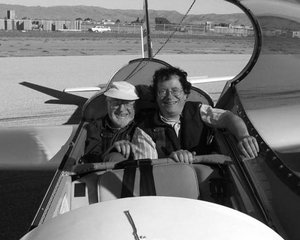
and a template image:

Generate the following result matrices (first row are the standard methods SQDIFF, CCORR and CCOEFF, second row are the same methods in its normalized version). In the first column, the darkest is the better match, for the other two columns, the brighter a location, the higher the match.
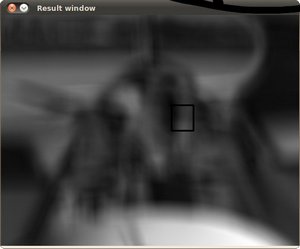
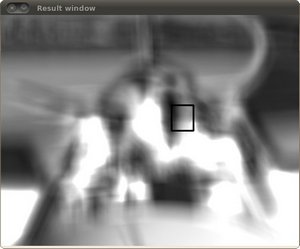
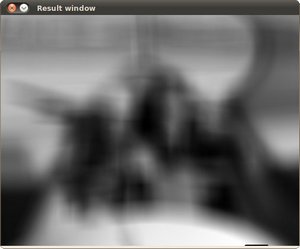
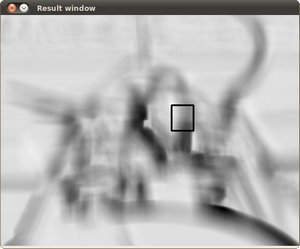
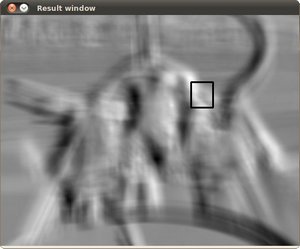
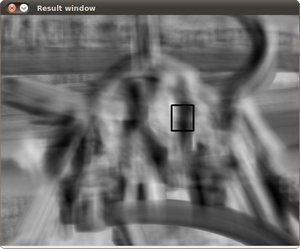
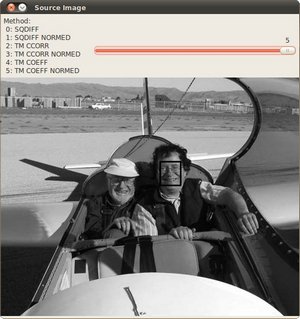
The right match is shown below (black rectangle around the face of the guy at the right). Notice that CCORR and CCDEFF gave erroneous best matches, however their normalized version did it right, this may be due to the fact that we are only considering the “highest match” and not the other possible high matches.