
Harris corner detector#
Goal#
In this tutorial you will learn:
What features are and why they are important
Use the function cv::cornerHarris to detect corners using the Harris-Stephens method.
Theory#
What is a feature?#
In computer vision, usually we need to find matching points between different frames of an environment. Why? If we know how two images relate to each other, we can use both images to extract information of them.
When we say matching points we are referring, in a general sense, to characteristics in the scene that we can recognize easily. We call these characteristics features.
So, what characteristics should a feature have?
It must be uniquely recognizable
Types of Image Features#
To mention a few:
Edges
Corners (also known as interest points)
Blobs (also known as regions of interest )
In this tutorial we will study the corner features, specifically.
Why is a corner so special?#
Because, since it is the intersection of two edges, it represents a point in which the directions of these two edges change. Hence, the gradient of the image (in both directions) have a high variation, which can be used to detect it.
How does it work?#
Let’s look for corners. Since corners represents a variation in the gradient in the image, we will look for this “variation”.
Consider a grayscale image \(I\). We are going to sweep a window \(w(x,y)\) (with displacements \(u\) in the x direction and \(v\) in the y direction) \(I\) and will calculate the variation of intensity.
\[ E(u,v) = \sum _{x,y} w(x,y)[ I(x+u,y+v) - I(x,y)]^{2} \]where:
\(w(x,y)\) is the window at position \((x,y)\)
\(I(x,y)\) is the intensity at \((x,y)\)
\(I(x+u,y+v)\) is the intensity at the moved window \((x+u,y+v)\)
Since we are looking for windows with corners, we are looking for windows with a large variation in intensity. Hence, we have to maximize the equation above, specifically the term:
\[ \sum _{x,y}[ I(x+u,y+v) - I(x,y)]^{2} \]Using Taylor expansion:
\[ E(u,v) \approx \sum _{x,y}[ I(x,y) + u I_{x} + vI_{y} - I(x,y)]^{2} \]Expanding the equation and cancelling properly:
\[ E(u,v) \approx \sum _{x,y} u^{2}I_{x}^{2} + 2uvI_{x}I_{y} + v^{2}I_{y}^{2} \]Which can be expressed in a matrix form as:
\[\begin{split}E(u,v) \approx \begin{bmatrix} u & v \end{bmatrix} \left ( \displaystyle \sum_{x,y} w(x,y) \begin{bmatrix} I_x^{2} & I_{x}I_{y} \\ I_xI_{y} & I_{y}^{2} \end{bmatrix} \right ) \begin{bmatrix} u \\ v \end{bmatrix}\end{split}\]Let’s denote:
\[\begin{split}M = \displaystyle \sum_{x,y} w(x,y) \begin{bmatrix} I_x^{2} & I_{x}I_{y} \\ I_xI_{y} & I_{y}^{2} \end{bmatrix}\end{split}\]So, our equation now is:
\[\begin{split}E(u,v) \approx \begin{bmatrix} u & v \end{bmatrix} M \begin{bmatrix} u \\ v \end{bmatrix}\end{split}\]A score is calculated for each window, to determine if it can possibly contain a corner:
\[ R = det(M) - k(trace(M))^{2} \]where:
det(M) = \(\lambda_{1}\lambda_{2}\)
trace(M) = \(\lambda_{1}+\lambda_{2}\)
a window with a score \(R\) greater than a certain value is considered a “corner”
Code#
This tutorial code’s is shown lines below. You can also download it from here
#include "opencv2/highgui.hpp"
#include "opencv2/imgproc.hpp"
#include <iostream>

using namespace cv;
using namespace std;

/// Global variables
Mat src, src_gray;
int thresh = 200;
int max_thresh = 255;

const char* source_window = "Source image";
const char* corners_window = "Corners detected";

/// Function header
void cornerHarris_demo( int, void* );

int main( int argc, char** argv )
{
    /// Load source image and convert it to gray
    CommandLineParser parser( argc, argv, "{@input | building.jpg | input image}" );
    src = imread( samples::findFile( parser.get<String>( "@input" ) ) );
    if ( src.empty() )
    {
        cout << "Could not open or find the image!\n" << endl;
        cout << "Usage: " << argv[0] << " <Input image>" << endl;
        return -1;
    }
    cvtColor( src, src_gray, COLOR_BGR2GRAY );

    /// Create a window and a trackbar
    namedWindow( source_window );
    createTrackbar( "Threshold: ", source_window, &thresh, max_thresh, cornerHarris_demo );
    imshow( source_window, src );

    cornerHarris_demo( 0, 0 );

    waitKey();
    return 0;
}

void cornerHarris_demo( int, void* )
{
    /// Detector parameters
    int blockSize = 2;
    int apertureSize = 3;
    double k = 0.04;

    /// Detecting corners
    Mat dst = Mat::zeros( src.size(), CV_32FC1 );
    cornerHarris( src_gray, dst, blockSize, apertureSize, k );

    /// Normalizing
    Mat dst_norm, dst_norm_scaled;
    normalize( dst, dst_norm, 0, 255, NORM_MINMAX, CV_32FC1, Mat() );
    convertScaleAbs( dst_norm, dst_norm_scaled );

    /// Drawing a circle around corners
    for( int i = 0; i < dst_norm.rows ; i++ )
    {
        for( int j = 0; j < dst_norm.cols; j++ )
        {
            if( (int) dst_norm.at<float>(i,j) > thresh )
            {
                circle( dst_norm_scaled, Point(j,i), 5,  Scalar(0), 2, 8, 0 );
            }
        }
    }

    /// Showing the result
    namedWindow( corners_window );
    imshow( corners_window, dst_norm_scaled );
}
This tutorial code’s is shown lines below. You can also download it from here
import java.awt.BorderLayout;
import java.awt.Container;
import java.awt.Image;

import javax.swing.BoxLayout;
import javax.swing.ImageIcon;
import javax.swing.JFrame;
import javax.swing.JLabel;
import javax.swing.JPanel;
import javax.swing.JSlider;
import javax.swing.event.ChangeEvent;
import javax.swing.event.ChangeListener;

import org.opencv.core.Core;
import org.opencv.core.CvType;
import org.opencv.core.Mat;
import org.opencv.core.Point;
import org.opencv.core.Scalar;
import org.opencv.highgui.HighGui;
import org.opencv.imgcodecs.Imgcodecs;
import org.opencv.imgproc.Imgproc;

class CornerHarris {
    private Mat srcGray = new Mat();
    private Mat dst = new Mat();
    private Mat dstNorm = new Mat();
    private Mat dstNormScaled = new Mat();
    private JFrame frame;
    private JLabel imgLabel;
    private JLabel cornerLabel;
    private static final int MAX_THRESHOLD = 255;
    private int threshold = 200;

    public CornerHarris(String[] args) {
        /// Load source image and convert it to gray
        String filename = args.length > 0 ? args[0] : "../data/building.jpg";
        Mat src = Imgcodecs.imread(filename);
        if (src.empty()) {
            System.err.println("Cannot read image: " + filename);
            System.exit(0);
        }

        Imgproc.cvtColor(src, srcGray, Imgproc.COLOR_BGR2GRAY);

        // Create and set up the window.
        frame = new JFrame("Harris corner detector demo");
        frame.setDefaultCloseOperation(JFrame.EXIT_ON_CLOSE);
        // Set up the content pane.
        Image img = HighGui.toBufferedImage(src);
        addComponentsToPane(frame.getContentPane(), img);
        // Use the content pane's default BorderLayout. No need for
        // setLayout(new BorderLayout());
        // Display the window.
        frame.pack();
        frame.setVisible(true);
        update();
    }

    private void addComponentsToPane(Container pane, Image img) {
        if (!(pane.getLayout() instanceof BorderLayout)) {
            pane.add(new JLabel("Container doesn't use BorderLayout!"));
            return;
        }

        JPanel sliderPanel = new JPanel();
        sliderPanel.setLayout(new BoxLayout(sliderPanel, BoxLayout.PAGE_AXIS));

        sliderPanel.add(new JLabel("Threshold: "));
        JSlider slider = new JSlider(0, MAX_THRESHOLD, threshold);
        slider.setMajorTickSpacing(20);
        slider.setMinorTickSpacing(10);
        slider.setPaintTicks(true);
        slider.setPaintLabels(true);
        slider.addChangeListener(new ChangeListener() {
            @Override
            public void stateChanged(ChangeEvent e) {
                JSlider source = (JSlider) e.getSource();
                threshold = source.getValue();
                update();
            }
        });
        sliderPanel.add(slider);
        pane.add(sliderPanel, BorderLayout.PAGE_START);

        JPanel imgPanel = new JPanel();
        imgLabel = new JLabel(new ImageIcon(img));
        imgPanel.add(imgLabel);

        Mat blackImg = Mat.zeros(srcGray.size(), CvType.CV_8U);
        cornerLabel = new JLabel(new ImageIcon(HighGui.toBufferedImage(blackImg)));
        imgPanel.add(cornerLabel);

        pane.add(imgPanel, BorderLayout.CENTER);
    }

    private void update() {
        dst = Mat.zeros(srcGray.size(), CvType.CV_32F);

        /// Detector parameters
        int blockSize = 2;
        int apertureSize = 3;
        double k = 0.04;

        /// Detecting corners
        Imgproc.cornerHarris(srcGray, dst, blockSize, apertureSize, k);

        /// Normalizing
        Core.normalize(dst, dstNorm, 0, 255, Core.NORM_MINMAX);
        Core.convertScaleAbs(dstNorm, dstNormScaled);

        /// Drawing a circle around corners
        float[] dstNormData = new float[(int) (dstNorm.total() * dstNorm.channels())];
        dstNorm.get(0, 0, dstNormData);

        for (int i = 0; i < dstNorm.rows(); i++) {
            for (int j = 0; j < dstNorm.cols(); j++) {
                if ((int) dstNormData[i * dstNorm.cols() + j] > threshold) {
                    Imgproc.circle(dstNormScaled, new Point(j, i), 5, new Scalar(0), 2, 8, 0);
                }
            }
        }

        cornerLabel.setIcon(new ImageIcon(HighGui.toBufferedImage(dstNormScaled)));
        frame.repaint();
    }
}

public class CornerHarrisDemo {
    public static void main(String[] args) {
        // Load the native OpenCV library
        System.loadLibrary(Core.NATIVE_LIBRARY_NAME);

        // Schedule a job for the event dispatch thread:
        // creating and showing this application's GUI.
        javax.swing.SwingUtilities.invokeLater(new Runnable() {
            @Override
            public void run() {
                new CornerHarris(args);
            }
        });
    }
}
This tutorial code’s is shown lines below. You can also download it from here
from __future__ import print_function
import cv2 as cv
import numpy as np
import argparse

source_window = 'Source image'
corners_window = 'Corners detected'
max_thresh = 255

def cornerHarris_demo(val):
    thresh = val

    # Detector parameters
    blockSize = 2
    apertureSize = 3
    k = 0.04

    # Detecting corners
    dst = cv.cornerHarris(src_gray, blockSize, apertureSize, k)

    # Normalizing
    dst_norm = np.empty(dst.shape, dtype=np.float32)
    cv.normalize(dst, dst_norm, alpha=0, beta=255, norm_type=cv.NORM_MINMAX)
    dst_norm_scaled = cv.convertScaleAbs(dst_norm)

    # Drawing a circle around corners
    for i in range(dst_norm.shape[0]):
        for j in range(dst_norm.shape[1]):
            if int(dst_norm[i,j]) > thresh:
                cv.circle(dst_norm_scaled, (j,i), 5, (0), 2)

    # Showing the result
    cv.namedWindow(corners_window)
    cv.imshow(corners_window, dst_norm_scaled)

# Load source image and convert it to gray
parser = argparse.ArgumentParser(description='Code for Harris corner detector tutorial.')
parser.add_argument('--input', help='Path to input image.', default='building.jpg')
args = parser.parse_args()

src = cv.imread(cv.samples.findFile(args.input))
if src is None:
    print('Could not open or find the image:', args.input)
    exit(0)

src_gray = cv.cvtColor(src, cv.COLOR_BGR2GRAY)

# Create a window and a trackbar
cv.namedWindow(source_window)
thresh = 200 # initial threshold
cv.createTrackbar('Threshold: ', source_window, thresh, max_thresh, cornerHarris_demo)
cv.imshow(source_window, src)
cornerHarris_demo(thresh)

cv.waitKey()
Explanation#
Result#
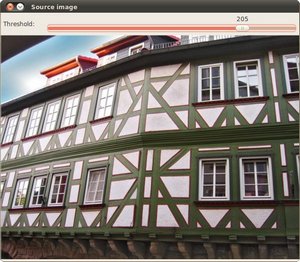
The original image:
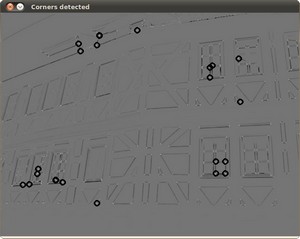
The detected corners are surrounded by a small black circle