
Features + Homography to find a known object#
Goal#
In this tutorial you will learn how to:
Use the function cv::findHomography to find the transform between matched keypoints.
Use the function cv::perspectiveTransform to map the points.
\warning You need the OpenCV contrib modules to be able to use the SURF features (alternatives are ORB, KAZE, … features).
Theory#
Code#
This tutorial code’s is shown lines below. You can also download it from here
#include <iostream>
#include "opencv2/core.hpp"
#ifdef HAVE_OPENCV_XFEATURES2D
#include "opencv2/geometry.hpp"
#include "opencv2/highgui.hpp"
#include "opencv2/imgproc.hpp"
#include "opencv2/features.hpp"
#include "opencv2/xfeatures2d.hpp"

using namespace cv;
using namespace cv::xfeatures2d;
using std::cout;
using std::endl;

const char* keys =
        "{ help h |                  | Print help message. }"
        "{ input1 | box.png          | Path to input image 1. }"
        "{ input2 | box_in_scene.png | Path to input image 2. }";

int main( int argc, char* argv[] )
{
    CommandLineParser parser( argc, argv, keys );
    Mat img_object = imread( samples::findFile( parser.get<String>("input1") ), IMREAD_GRAYSCALE );
    Mat img_scene = imread( samples::findFile( parser.get<String>("input2") ), IMREAD_GRAYSCALE );
    if ( img_object.empty() || img_scene.empty() )
    {
        cout << "Could not open or find the image!\n" << endl;
        parser.printMessage();
        return -1;
    }

    //-- Step 1: Detect the keypoints using SURF Detector, compute the descriptors
    int minHessian = 400;
    Ptr<SURF> detector = SURF::create( minHessian );
    std::vector<KeyPoint> keypoints_object, keypoints_scene;
    Mat descriptors_object, descriptors_scene;
    detector->detectAndCompute( img_object, noArray(), keypoints_object, descriptors_object );
    detector->detectAndCompute( img_scene, noArray(), keypoints_scene, descriptors_scene );

    //-- Step 2: Matching descriptor vectors with a FLANN based matcher
    // Since SURF is a floating-point descriptor NORM_L2 is used
    Ptr<DescriptorMatcher> matcher = DescriptorMatcher::create(DescriptorMatcher::FLANNBASED);
    std::vector< std::vector<DMatch> > knn_matches;
    matcher->knnMatch( descriptors_object, descriptors_scene, knn_matches, 2 );

    //-- Filter matches using the Lowe's ratio test
    const float ratio_thresh = 0.75f;
    std::vector<DMatch> good_matches;
    for (size_t i = 0; i < knn_matches.size(); i++)
    {
        if (knn_matches[i][0].distance < ratio_thresh * knn_matches[i][1].distance)
        {
            good_matches.push_back(knn_matches[i][0]);
        }
    }

    //-- Draw matches
    Mat img_matches;
    drawMatches( img_object, keypoints_object, img_scene, keypoints_scene, good_matches, img_matches, Scalar::all(-1),
                 Scalar::all(-1), std::vector<char>(), DrawMatchesFlags::NOT_DRAW_SINGLE_POINTS );

    //-- Localize the object
    std::vector<Point2f> obj;
    std::vector<Point2f> scene;

    for( size_t i = 0; i < good_matches.size(); i++ )
    {
        //-- Get the keypoints from the good matches
        obj.push_back( keypoints_object[ good_matches[i].queryIdx ].pt );
        scene.push_back( keypoints_scene[ good_matches[i].trainIdx ].pt );
    }

    Mat H = findHomography( obj, scene, RANSAC );

    //-- Get the corners from the image_1 ( the object to be "detected" )
    std::vector<Point2f> obj_corners(4);
    obj_corners[0] = Point2f(0, 0);
    obj_corners[1] = Point2f( (float)img_object.cols, 0 );
    obj_corners[2] = Point2f( (float)img_object.cols, (float)img_object.rows );
    obj_corners[3] = Point2f( 0, (float)img_object.rows );
    std::vector<Point2f> scene_corners(4);

    perspectiveTransform( obj_corners, scene_corners, H);

    //-- Draw lines between the corners (the mapped object in the scene - image_2 )
    line( img_matches, scene_corners[0] + Point2f((float)img_object.cols, 0),
          scene_corners[1] + Point2f((float)img_object.cols, 0), Scalar(0, 255, 0), 4 );
    line( img_matches, scene_corners[1] + Point2f((float)img_object.cols, 0),
          scene_corners[2] + Point2f((float)img_object.cols, 0), Scalar( 0, 255, 0), 4 );
    line( img_matches, scene_corners[2] + Point2f((float)img_object.cols, 0),
          scene_corners[3] + Point2f((float)img_object.cols, 0), Scalar( 0, 255, 0), 4 );
    line( img_matches, scene_corners[3] + Point2f((float)img_object.cols, 0),
          scene_corners[0] + Point2f((float)img_object.cols, 0), Scalar( 0, 255, 0), 4 );

    //-- Show detected matches
    imshow("Good Matches & Object detection", img_matches );

    waitKey();
    return 0;
}
#else
int main()
{
    std::cout << "This tutorial code needs the xfeatures2d contrib module to be run." << std::endl;
    return 0;
}
#endif
This tutorial code’s is shown lines below. You can also download it from here
import java.util.ArrayList;
import java.util.List;

import org.opencv.geometry.Geometry;
import org.opencv.core.Core;
import org.opencv.core.CvType;
import org.opencv.core.DMatch;
import org.opencv.core.KeyPoint;
import org.opencv.core.Mat;
import org.opencv.core.MatOfByte;
import org.opencv.core.MatOfDMatch;
import org.opencv.core.MatOfKeyPoint;
import org.opencv.core.MatOfPoint2f;
import org.opencv.core.Point;
import org.opencv.core.Scalar;
import org.opencv.features.DescriptorMatcher;
import org.opencv.features.Features;
import org.opencv.highgui.HighGui;
import org.opencv.imgcodecs.Imgcodecs;
import org.opencv.imgproc.Imgproc;
import org.opencv.xfeatures2d.SURF;

class SURFFLANNMatchingHomography {
    public void run(String[] args) {
        String filenameObject = args.length > 1 ? args[0] : "../data/box.png";
        String filenameScene = args.length > 1 ? args[1] : "../data/box_in_scene.png";
        Mat imgObject = Imgcodecs.imread(filenameObject, Imgcodecs.IMREAD_GRAYSCALE);
        Mat imgScene = Imgcodecs.imread(filenameScene, Imgcodecs.IMREAD_GRAYSCALE);
        if (imgObject.empty() || imgScene.empty()) {
            System.err.println("Cannot read images!");
            System.exit(0);
        }

        //-- Step 1: Detect the keypoints using SURF Detector, compute the descriptors
        double hessianThreshold = 400;
        int nOctaves = 4, nOctaveLayers = 3;
        boolean extended = false, upright = false;
        SURF detector = SURF.create(hessianThreshold, nOctaves, nOctaveLayers, extended, upright);
        MatOfKeyPoint keypointsObject = new MatOfKeyPoint(), keypointsScene = new MatOfKeyPoint();
        Mat descriptorsObject = new Mat(), descriptorsScene = new Mat();
        detector.detectAndCompute(imgObject, new Mat(), keypointsObject, descriptorsObject);
        detector.detectAndCompute(imgScene, new Mat(), keypointsScene, descriptorsScene);

        //-- Step 2: Matching descriptor vectors with a FLANN based matcher
        // Since SURF is a floating-point descriptor NORM_L2 is used
        DescriptorMatcher matcher = DescriptorMatcher.create(DescriptorMatcher.FLANNBASED);
        List<MatOfDMatch> knnMatches = new ArrayList<>();
        matcher.knnMatch(descriptorsObject, descriptorsScene, knnMatches, 2);

        //-- Filter matches using the Lowe's ratio test
        float ratioThresh = 0.75f;
        List<DMatch> listOfGoodMatches = new ArrayList<>();
        for (int i = 0; i < knnMatches.size(); i++) {
            if (knnMatches.get(i).rows() > 1) {
                DMatch[] matches = knnMatches.get(i).toArray();
                if (matches[0].distance < ratioThresh * matches[1].distance) {
                    listOfGoodMatches.add(matches[0]);
                }
            }
        }
        MatOfDMatch goodMatches = new MatOfDMatch();
        goodMatches.fromList(listOfGoodMatches);

        //-- Draw matches
        Mat imgMatches = new Mat();
        Features.drawMatches(imgObject, keypointsObject, imgScene, keypointsScene, goodMatches, imgMatches, Scalar.all(-1),
                Scalar.all(-1), new MatOfByte(), Features.DrawMatchesFlags_NOT_DRAW_SINGLE_POINTS);

        //-- Localize the object
        List<Point> obj = new ArrayList<>();
        List<Point> scene = new ArrayList<>();

        List<KeyPoint> listOfKeypointsObject = keypointsObject.toList();
        List<KeyPoint> listOfKeypointsScene = keypointsScene.toList();
        for (int i = 0; i < listOfGoodMatches.size(); i++) {
            //-- Get the keypoints from the good matches
            obj.add(listOfKeypointsObject.get(listOfGoodMatches.get(i).queryIdx).pt);
            scene.add(listOfKeypointsScene.get(listOfGoodMatches.get(i).trainIdx).pt);
        }

        MatOfPoint2f objMat = new MatOfPoint2f(), sceneMat = new MatOfPoint2f();
        objMat.fromList(obj);
        sceneMat.fromList(scene);
        double ransacReprojThreshold = 3.0;
        Mat H = Geometry.findHomography( objMat, sceneMat, Geometry.RANSAC, ransacReprojThreshold );

        //-- Get the corners from the image_1 ( the object to be "detected" )
        Mat objCorners = new Mat(4, 1, CvType.CV_32FC2), sceneCorners = new Mat();
        float[] objCornersData = new float[(int) (objCorners.total() * objCorners.channels())];
        objCorners.get(0, 0, objCornersData);
        objCornersData[0] = 0;
        objCornersData[1] = 0;
        objCornersData[2] = imgObject.cols();
        objCornersData[3] = 0;
        objCornersData[4] = imgObject.cols();
        objCornersData[5] = imgObject.rows();
        objCornersData[6] = 0;
        objCornersData[7] = imgObject.rows();
        objCorners.put(0, 0, objCornersData);

        Core.perspectiveTransform(objCorners, sceneCorners, H);
        float[] sceneCornersData = new float[(int) (sceneCorners.total() * sceneCorners.channels())];
        sceneCorners.get(0, 0, sceneCornersData);

        //-- Draw lines between the corners (the mapped object in the scene - image_2 )
        Imgproc.line(imgMatches, new Point(sceneCornersData[0] + imgObject.cols(), sceneCornersData[1]),
                new Point(sceneCornersData[2] + imgObject.cols(), sceneCornersData[3]), new Scalar(0, 255, 0), 4);
        Imgproc.line(imgMatches, new Point(sceneCornersData[2] + imgObject.cols(), sceneCornersData[3]),
                new Point(sceneCornersData[4] + imgObject.cols(), sceneCornersData[5]), new Scalar(0, 255, 0), 4);
        Imgproc.line(imgMatches, new Point(sceneCornersData[4] + imgObject.cols(), sceneCornersData[5]),
                new Point(sceneCornersData[6] + imgObject.cols(), sceneCornersData[7]), new Scalar(0, 255, 0), 4);
        Imgproc.line(imgMatches, new Point(sceneCornersData[6] + imgObject.cols(), sceneCornersData[7]),
                new Point(sceneCornersData[0] + imgObject.cols(), sceneCornersData[1]), new Scalar(0, 255, 0), 4);

        //-- Show detected matches
        HighGui.imshow("Good Matches & Object detection", imgMatches);
        HighGui.waitKey(0);

        System.exit(0);
    }
}

public class SURFFLANNMatchingHomographyDemo {
    public static void main(String[] args) {
        // Load the native OpenCV library
        System.loadLibrary(Core.NATIVE_LIBRARY_NAME);

        new SURFFLANNMatchingHomography().run(args);
    }
}
This tutorial code’s is shown lines below. You can also download it from here
from __future__ import print_function
import cv2 as cv
import numpy as np
import argparse

parser = argparse.ArgumentParser(description='Code for Feature Matching with FLANN tutorial.')
parser.add_argument('--input1', help='Path to input image 1.', default='box.png')
parser.add_argument('--input2', help='Path to input image 2.', default='box_in_scene.png')
args = parser.parse_args()

img_object = cv.imread(cv.samples.findFile(args.input1), cv.IMREAD_GRAYSCALE)
img_scene = cv.imread(cv.samples.findFile(args.input2), cv.IMREAD_GRAYSCALE)
if img_object is None or img_scene is None:
    print('Could not open or find the images!')
    exit(0)

#-- Step 1: Detect the keypoints using SURF Detector, compute the descriptors
minHessian = 400
detector = cv.xfeatures2d_SURF.create(hessianThreshold=minHessian)
keypoints_obj, descriptors_obj = detector.detectAndCompute(img_object, None)
keypoints_scene, descriptors_scene = detector.detectAndCompute(img_scene, None)

#-- Step 2: Matching descriptor vectors with a FLANN based matcher
# Since SURF is a floating-point descriptor NORM_L2 is used
matcher = cv.DescriptorMatcher_create(cv.DescriptorMatcher_FLANNBASED)
knn_matches = matcher.knnMatch(descriptors_obj, descriptors_scene, 2)

#-- Filter matches using the Lowe's ratio test
ratio_thresh = 0.75
good_matches = []
for m,n in knn_matches:
    if m.distance < ratio_thresh * n.distance:
        good_matches.append(m)

#-- Draw matches
img_matches = np.empty((max(img_object.shape[0], img_scene.shape[0]), img_object.shape[1]+img_scene.shape[1], 3), dtype=np.uint8)
cv.drawMatches(img_object, keypoints_obj, img_scene, keypoints_scene, good_matches, img_matches, flags=cv.DrawMatchesFlags_NOT_DRAW_SINGLE_POINTS)

#-- Localize the object
obj = np.empty((len(good_matches),2), dtype=np.float32)
scene = np.empty((len(good_matches),2), dtype=np.float32)
for i in range(len(good_matches)):
    #-- Get the keypoints from the good matches
    obj[i,0] = keypoints_obj[good_matches[i].queryIdx].pt[0]
    obj[i,1] = keypoints_obj[good_matches[i].queryIdx].pt[1]
    scene[i,0] = keypoints_scene[good_matches[i].trainIdx].pt[0]
    scene[i,1] = keypoints_scene[good_matches[i].trainIdx].pt[1]

H, _ =  cv.findHomography(obj, scene, cv.RANSAC)

#-- Get the corners from the image_1 ( the object to be "detected" )
obj_corners = np.empty((4,1,2), dtype=np.float32)
obj_corners[0,0,0] = 0
obj_corners[0,0,1] = 0
obj_corners[1,0,0] = img_object.shape[1]
obj_corners[1,0,1] = 0
obj_corners[2,0,0] = img_object.shape[1]
obj_corners[2,0,1] = img_object.shape[0]
obj_corners[3,0,0] = 0
obj_corners[3,0,1] = img_object.shape[0]

scene_corners = cv.perspectiveTransform(obj_corners, H)

#-- Draw lines between the corners (the mapped object in the scene - image_2 )
cv.line(img_matches, (int(scene_corners[0,0,0] + img_object.shape[1]), int(scene_corners[0,0,1])),\
    (int(scene_corners[1,0,0] + img_object.shape[1]), int(scene_corners[1,0,1])), (0,255,0), 4)
cv.line(img_matches, (int(scene_corners[1,0,0] + img_object.shape[1]), int(scene_corners[1,0,1])),\
    (int(scene_corners[2,0,0] + img_object.shape[1]), int(scene_corners[2,0,1])), (0,255,0), 4)
cv.line(img_matches, (int(scene_corners[2,0,0] + img_object.shape[1]), int(scene_corners[2,0,1])),\
    (int(scene_corners[3,0,0] + img_object.shape[1]), int(scene_corners[3,0,1])), (0,255,0), 4)
cv.line(img_matches, (int(scene_corners[3,0,0] + img_object.shape[1]), int(scene_corners[3,0,1])),\
    (int(scene_corners[0,0,0] + img_object.shape[1]), int(scene_corners[0,0,1])), (0,255,0), 4)

#-- Show detected matches
cv.imshow('Good Matches & Object detection', img_matches)

cv.waitKey()
Explanation#
Result#
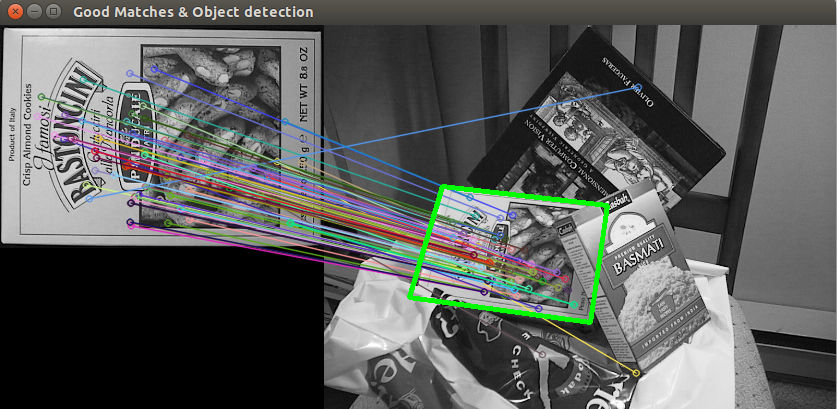
And here is the result for the detected object (highlighted in green). Note that since the homography is estimated with a RANSAC approach, detected false matches will not impact the homography calculation.