

AKAZE local features matching#
Introduction#
In this tutorial we will learn how to use AKAZE [12] local features to detect and match keypoints on two images. We will find keypoints on a pair of images with given homography matrix, match them and count the number of inliers (i.e. matches that fit in the given homography).
You can find expanded version of this example here: pablofdezalc/test_kaze_akaze_opencv
\warning You need the OpenCV contrib module xfeatures2d to be able to use the AKAZE features.
Data#
We are going to use images 1 and 3 from Graffiti sequence of Oxford dataset.
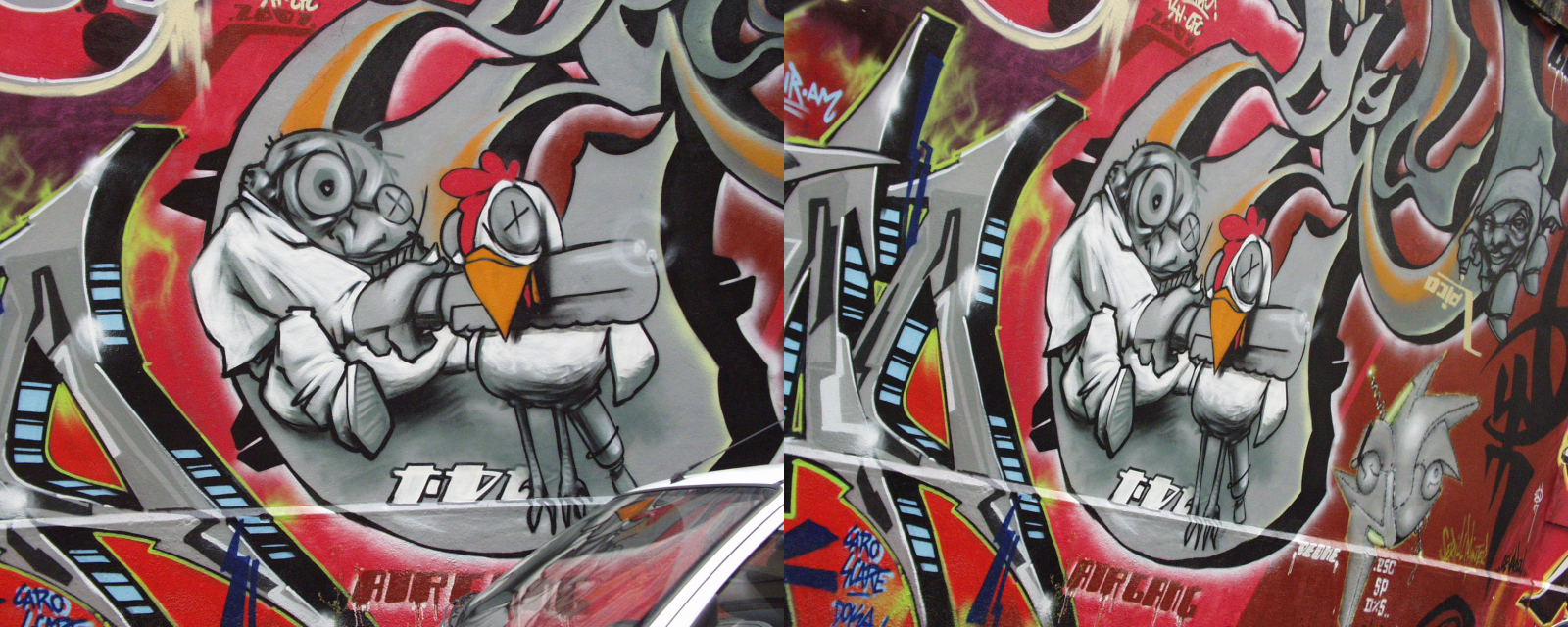
Homography is given by a 3 by 3 matrix:
7.6285898e-01  -2.9922929e-01   2.2567123e+02
3.3443473e-01   1.0143901e+00  -7.6999973e+01
3.4663091e-04  -1.4364524e-05   1.0000000e+00
You can find the images (graf1.png, graf3.png) and homography (H1to3p.xml) in opencv/samples/data/.
Source Code#
Downloadable code: Click here
Code at glance:
#include <iostream>
#ifdef HAVE_OPENCV_XFEATURES2D
#include <opencv2/features.hpp>
#include "opencv2/xfeatures2d.hpp"
#include <opencv2/imgproc.hpp>
#include <opencv2/highgui.hpp>

using namespace std;
using namespace cv;

const float inlier_threshold = 2.5f; // Distance threshold to identify inliers with homography check
const float nn_match_ratio = 0.8f;   // Nearest neighbor matching ratio

int main(int argc, char* argv[])
{
    CommandLineParser parser(argc, argv,
                             "{@img1 | graf1.png | input image 1}"
                             "{@img2 | graf3.png | input image 2}"
                             "{@homography | H1to3p.xml | homography matrix}");
    Mat img1 = imread( samples::findFile( parser.get<String>("@img1") ), IMREAD_GRAYSCALE);
    Mat img2 = imread( samples::findFile( parser.get<String>("@img2") ), IMREAD_GRAYSCALE);

    Mat homography;
    FileStorage fs( samples::findFile( parser.get<String>("@homography") ), FileStorage::READ);
    fs.getFirstTopLevelNode() >> homography;

    vector<KeyPoint> kpts1, kpts2;
    Mat desc1, desc2;

    Ptr<xfeatures2d::AKAZE> akaze = xfeatures2d::AKAZE::create();
    akaze->detectAndCompute(img1, noArray(), kpts1, desc1);
    akaze->detectAndCompute(img2, noArray(), kpts2, desc2);

    BFMatcher matcher(NORM_HAMMING);
    vector< vector<DMatch> > nn_matches;
    matcher.knnMatch(desc1, desc2, nn_matches, 2);

    vector<KeyPoint> matched1, matched2;
    for(size_t i = 0; i < nn_matches.size(); i++) {
        DMatch first = nn_matches[i][0];
        float dist1 = nn_matches[i][0].distance;
        float dist2 = nn_matches[i][1].distance;

        if(dist1 < nn_match_ratio * dist2) {
            matched1.push_back(kpts1[first.queryIdx]);
            matched2.push_back(kpts2[first.trainIdx]);
        }
    }

    vector<DMatch> good_matches;
    vector<KeyPoint> inliers1, inliers2;
    for(size_t i = 0; i < matched1.size(); i++) {
        Mat col = Mat::ones(3, 1, CV_64F);
        col.at<double>(0) = matched1[i].pt.x;
        col.at<double>(1) = matched1[i].pt.y;

        col = homography * col;
        col /= col.at<double>(2);
        double dist = sqrt( pow(col.at<double>(0) - matched2[i].pt.x, 2) +
                            pow(col.at<double>(1) - matched2[i].pt.y, 2));

        if(dist < inlier_threshold) {
            int new_i = static_cast<int>(inliers1.size());
            inliers1.push_back(matched1[i]);
            inliers2.push_back(matched2[i]);
            good_matches.push_back(DMatch(new_i, new_i, 0));
        }
    }

    Mat res;
    drawMatches(img1, inliers1, img2, inliers2, good_matches, res);
    imwrite("akaze_result.png", res);

    double inlier_ratio = inliers1.size() / (double) matched1.size();
    cout << "A-KAZE Matching Results" << endl;
    cout << "*******************************" << endl;
    cout << "# Keypoints 1:                        \t" << kpts1.size() << endl;
    cout << "# Keypoints 2:                        \t" << kpts2.size() << endl;
    cout << "# Matches:                            \t" << matched1.size() << endl;
    cout << "# Inliers:                            \t" << inliers1.size() << endl;
    cout << "# Inliers Ratio:                      \t" << inlier_ratio << endl;
    cout << endl;

    imshow("result", res);
    waitKey();

    return 0;
}
#else
int main()
{
    std::cout << "This tutorial code needs the xfeatures2d contrib module to be run." << std::endl;
    return 0;
}
#endif
Downloadable code: Click here
Code at glance:
import java.io.File;
import java.io.IOException;
import java.util.ArrayList;
import java.util.List;

import javax.xml.parsers.DocumentBuilder;
import javax.xml.parsers.DocumentBuilderFactory;
import javax.xml.parsers.ParserConfigurationException;

import org.opencv.core.Core;
import org.opencv.core.CvType;
import org.opencv.core.DMatch;
import org.opencv.core.KeyPoint;
import org.opencv.core.Mat;
import org.opencv.core.MatOfDMatch;
import org.opencv.core.MatOfKeyPoint;
import org.opencv.core.Scalar;
import org.opencv.xfeatures2d.AKAZE;
import org.opencv.features.DescriptorMatcher;
import org.opencv.features.Features;
import org.opencv.highgui.HighGui;
import org.opencv.imgcodecs.Imgcodecs;
import org.w3c.dom.Document;
import org.xml.sax.SAXException;

class AKAZEMatch {
    public void run(String[] args) {
        String filename1 = args.length > 2 ? args[0] : "../data/graf1.png";
        String filename2 = args.length > 2 ? args[1] : "../data/graf3.png";
        String filename3 = args.length > 2 ? args[2] : "../data/H1to3p.xml";
        Mat img1 = Imgcodecs.imread(filename1, Imgcodecs.IMREAD_GRAYSCALE);
        Mat img2 = Imgcodecs.imread(filename2, Imgcodecs.IMREAD_GRAYSCALE);
        if (img1.empty() || img2.empty()) {
            System.err.println("Cannot read images!");
            System.exit(0);
        }

        File file = new File(filename3);
        DocumentBuilderFactory documentBuilderFactory = DocumentBuilderFactory.newInstance();
        DocumentBuilder documentBuilder;
        Document document;
        Mat homography = new Mat(3, 3, CvType.CV_64F);
        double[] homographyData = new double[(int) (homography.total()*homography.channels())];
        try {
            documentBuilder = documentBuilderFactory.newDocumentBuilder();
            document = documentBuilder.parse(file);
            String homographyStr = document.getElementsByTagName("data").item(0).getTextContent();
            String[] splited = homographyStr.split("\\s+");
            int idx = 0;
            for (String s : splited) {
                if (!s.isEmpty()) {
                    homographyData[idx] = Double.parseDouble(s);
                    idx++;
                }
            }
        } catch (ParserConfigurationException e) {
            e.printStackTrace();
            System.exit(0);
        } catch (SAXException e) {
            e.printStackTrace();
            System.exit(0);
        } catch (IOException e) {
            e.printStackTrace();
            System.exit(0);
        }
        homography.put(0, 0, homographyData);

        AKAZE akaze = AKAZE.create();
        MatOfKeyPoint kpts1 = new MatOfKeyPoint(), kpts2 = new MatOfKeyPoint();
        Mat desc1 = new Mat(), desc2 = new Mat();
        akaze.detectAndCompute(img1, new Mat(), kpts1, desc1);
        akaze.detectAndCompute(img2, new Mat(), kpts2, desc2);

        DescriptorMatcher matcher = DescriptorMatcher.create(DescriptorMatcher.BRUTEFORCE_HAMMING);
        List<MatOfDMatch> knnMatches = new ArrayList<>();
        matcher.knnMatch(desc1, desc2, knnMatches, 2);

        float ratioThreshold = 0.8f; // Nearest neighbor matching ratio
        List<KeyPoint> listOfMatched1 = new ArrayList<>();
        List<KeyPoint> listOfMatched2 = new ArrayList<>();
        List<KeyPoint> listOfKeypoints1 = kpts1.toList();
        List<KeyPoint> listOfKeypoints2 = kpts2.toList();
        for (int i = 0; i < knnMatches.size(); i++) {
            DMatch[] matches = knnMatches.get(i).toArray();
            float dist1 = matches[0].distance;
            float dist2 = matches[1].distance;
            if (dist1 < ratioThreshold * dist2) {
                listOfMatched1.add(listOfKeypoints1.get(matches[0].queryIdx));
                listOfMatched2.add(listOfKeypoints2.get(matches[0].trainIdx));
            }
        }

        double inlierThreshold = 2.5; // Distance threshold to identify inliers with homography check
        List<KeyPoint> listOfInliers1 = new ArrayList<>();
        List<KeyPoint> listOfInliers2 = new ArrayList<>();
        List<DMatch> listOfGoodMatches = new ArrayList<>();
        for (int i = 0; i < listOfMatched1.size(); i++) {
            Mat col = new Mat(3, 1, CvType.CV_64F);
            double[] colData = new double[(int) (col.total() * col.channels())];
            colData[0] = listOfMatched1.get(i).pt.x;
            colData[1] = listOfMatched1.get(i).pt.y;
            colData[2] = 1.0;
            col.put(0, 0, colData);

            Mat colRes = new Mat();
            Core.gemm(homography, col, 1.0, new Mat(), 0.0, colRes);
            colRes.get(0, 0, colData);
            Core.multiply(colRes, new Scalar(1.0 / colData[2]), col);
            col.get(0, 0, colData);

            double dist = Math.sqrt(Math.pow(colData[0] - listOfMatched2.get(i).pt.x, 2) +
                    Math.pow(colData[1] - listOfMatched2.get(i).pt.y, 2));

            if (dist < inlierThreshold) {
                listOfGoodMatches.add(new DMatch(listOfInliers1.size(), listOfInliers2.size(), 0));
                listOfInliers1.add(listOfMatched1.get(i));
                listOfInliers2.add(listOfMatched2.get(i));
            }
        }

        Mat res = new Mat();
        MatOfKeyPoint inliers1 = new MatOfKeyPoint(listOfInliers1.toArray(new KeyPoint[listOfInliers1.size()]));
        MatOfKeyPoint inliers2 = new MatOfKeyPoint(listOfInliers2.toArray(new KeyPoint[listOfInliers2.size()]));
        MatOfDMatch goodMatches = new MatOfDMatch(listOfGoodMatches.toArray(new DMatch[listOfGoodMatches.size()]));
        Features.drawMatches(img1, inliers1, img2, inliers2, goodMatches, res);
        Imgcodecs.imwrite("akaze_result.png", res);

        double inlierRatio = listOfInliers1.size() / (double) listOfMatched1.size();
        System.out.println("A-KAZE Matching Results");
        System.out.println("*******************************");
        System.out.println("# Keypoints 1:                        \t" + listOfKeypoints1.size());
        System.out.println("# Keypoints 2:                        \t" + listOfKeypoints2.size());
        System.out.println("# Matches:                            \t" + listOfMatched1.size());
        System.out.println("# Inliers:                            \t" + listOfInliers1.size());
        System.out.println("# Inliers Ratio:                      \t" + inlierRatio);

        HighGui.imshow("result", res);
        HighGui.waitKey();

        System.exit(0);
    }
}

public class AKAZEMatchDemo {
    public static void main(String[] args) {
        // Load the native OpenCV library
        System.loadLibrary(Core.NATIVE_LIBRARY_NAME);

        new AKAZEMatch().run(args);
    }
}
Downloadable code: Click here
Code at glance:
from __future__ import print_function
import cv2 as cv
import numpy as np
import argparse
from math import sqrt

parser = argparse.ArgumentParser(description='Code for AKAZE local features matching tutorial.')
parser.add_argument('--input1', help='Path to input image 1.', default='graf1.png')
parser.add_argument('--input2', help='Path to input image 2.', default='graf3.png')
parser.add_argument('--homography', help='Path to the homography matrix.', default='H1to3p.xml')
args = parser.parse_args()

img1 = cv.imread(cv.samples.findFile(args.input1), cv.IMREAD_GRAYSCALE)
img2 = cv.imread(cv.samples.findFile(args.input2), cv.IMREAD_GRAYSCALE)
if img1 is None or img2 is None:
    print('Could not open or find the images!')
    exit(0)

fs = cv.FileStorage(cv.samples.findFile(args.homography), cv.FILE_STORAGE_READ)
homography = fs.getFirstTopLevelNode().mat()

akaze = cv.xfeatures2d.AKAZE_create()
kpts1, desc1 = akaze.detectAndCompute(img1, None)
kpts2, desc2 = akaze.detectAndCompute(img2, None)

matcher = cv.DescriptorMatcher_create(cv.DescriptorMatcher_BRUTEFORCE_HAMMING)
nn_matches = matcher.knnMatch(desc1, desc2, 2)

matched1 = []
matched2 = []
nn_match_ratio = 0.8 # Nearest neighbor matching ratio
for m, n in nn_matches:
    if m.distance < nn_match_ratio * n.distance:
        matched1.append(kpts1[m.queryIdx])
        matched2.append(kpts2[m.trainIdx])

inliers1 = []
inliers2 = []
good_matches = []
inlier_threshold = 2.5 # Distance threshold to identify inliers with homography check
for i, m in enumerate(matched1):
    col = np.ones((3,1), dtype=np.float64)
    col[0:2,0] = m.pt

    col = np.dot(homography, col)
    col /= col[2,0]
    dist = sqrt(pow(col[0,0] - matched2[i].pt[0], 2) +\
                pow(col[1,0] - matched2[i].pt[1], 2))

    if dist < inlier_threshold:
        good_matches.append(cv.DMatch(len(inliers1), len(inliers2), 0))
        inliers1.append(matched1[i])
        inliers2.append(matched2[i])

res = np.empty((max(img1.shape[0], img2.shape[0]), img1.shape[1]+img2.shape[1], 3), dtype=np.uint8)
cv.drawMatches(img1, inliers1, img2, inliers2, good_matches, res)
cv.imwrite("akaze_result.png", res)

inlier_ratio = len(inliers1) / float(len(matched1))
print('A-KAZE Matching Results')
print('*******************************')
print('# Keypoints 1:                        \t', len(kpts1))
print('# Keypoints 2:                        \t', len(kpts2))
print('# Matches:                            \t', len(matched1))
print('# Inliers:                            \t', len(inliers1))
print('# Inliers Ratio:                      \t', inlier_ratio)

cv.imshow('result', res)
cv.waitKey()
Explanation#
Load images and homography
CommandLineParser parser(argc, argv,
                         "{@img1 | graf1.png | input image 1}"
                         "{@img2 | graf3.png | input image 2}"
                         "{@homography | H1to3p.xml | homography matrix}");
Mat img1 = imread( samples::findFile( parser.get<String>("@img1") ), IMREAD_GRAYSCALE);
Mat img2 = imread( samples::findFile( parser.get<String>("@img2") ), IMREAD_GRAYSCALE);

Mat homography;
FileStorage fs( samples::findFile( parser.get<String>("@homography") ), FileStorage::READ);
fs.getFirstTopLevelNode() >> homography;
String filename1 = args.length > 2 ? args[0] : "../data/graf1.png";
String filename2 = args.length > 2 ? args[1] : "../data/graf3.png";
String filename3 = args.length > 2 ? args[2] : "../data/H1to3p.xml";
Mat img1 = Imgcodecs.imread(filename1, Imgcodecs.IMREAD_GRAYSCALE);
Mat img2 = Imgcodecs.imread(filename2, Imgcodecs.IMREAD_GRAYSCALE);
if (img1.empty() || img2.empty()) {
    System.err.println("Cannot read images!");
    System.exit(0);
}

File file = new File(filename3);
DocumentBuilderFactory documentBuilderFactory = DocumentBuilderFactory.newInstance();
DocumentBuilder documentBuilder;
Document document;
Mat homography = new Mat(3, 3, CvType.CV_64F);
double[] homographyData = new double[(int) (homography.total()*homography.channels())];
try {
    documentBuilder = documentBuilderFactory.newDocumentBuilder();
    document = documentBuilder.parse(file);
    String homographyStr = document.getElementsByTagName("data").item(0).getTextContent();
    String[] splited = homographyStr.split("\\s+");
    int idx = 0;
    for (String s : splited) {
        if (!s.isEmpty()) {
            homographyData[idx] = Double.parseDouble(s);
            idx++;
        }
    }
} catch (ParserConfigurationException e) {
    e.printStackTrace();
    System.exit(0);
} catch (SAXException e) {
    e.printStackTrace();
    System.exit(0);
} catch (IOException e) {
    e.printStackTrace();
    System.exit(0);
}
homography.put(0, 0, homographyData);
parser = argparse.ArgumentParser(description='Code for AKAZE local features matching tutorial.')
parser.add_argument('--input1', help='Path to input image 1.', default='graf1.png')
parser.add_argument('--input2', help='Path to input image 2.', default='graf3.png')
parser.add_argument('--homography', help='Path to the homography matrix.', default='H1to3p.xml')
args = parser.parse_args()

img1 = cv.imread(cv.samples.findFile(args.input1), cv.IMREAD_GRAYSCALE)
img2 = cv.imread(cv.samples.findFile(args.input2), cv.IMREAD_GRAYSCALE)
if img1 is None or img2 is None:
    print('Could not open or find the images!')
    exit(0)

fs = cv.FileStorage(cv.samples.findFile(args.homography), cv.FILE_STORAGE_READ)
homography = fs.getFirstTopLevelNode().mat()
We are loading grayscale images here. Homography is stored in the xml created with FileStorage.
Detect keypoints and compute descriptors using AKAZE
akaze = cv.xfeatures2d.AKAZE_create()
kpts1, desc1 = akaze.detectAndCompute(img1, None)
kpts2, desc2 = akaze.detectAndCompute(img2, None)
We create AKAZE and detect and compute AKAZE keypoints and descriptors. Since we don’t need the mask parameter, noArray() is used.
Use brute-force matcher to find 2-nn matches
DescriptorMatcher matcher = DescriptorMatcher.create(DescriptorMatcher.BRUTEFORCE_HAMMING);
List<MatOfDMatch> knnMatches = new ArrayList<>();
matcher.knnMatch(desc1, desc2, knnMatches, 2);
matcher = cv.DescriptorMatcher_create(cv.DescriptorMatcher_BRUTEFORCE_HAMMING)
nn_matches = matcher.knnMatch(desc1, desc2, 2)
We use Hamming distance, because AKAZE uses binary descriptor by default.
Use 2-nn matches and ratio criterion to find correct keypoint matches
vector<KeyPoint> matched1, matched2;
for(size_t i = 0; i < nn_matches.size(); i++) {
    DMatch first = nn_matches[i][0];
    float dist1 = nn_matches[i][0].distance;
    float dist2 = nn_matches[i][1].distance;

    if(dist1 < nn_match_ratio * dist2) {
        matched1.push_back(kpts1[first.queryIdx]);
        matched2.push_back(kpts2[first.trainIdx]);
    }
}
float ratioThreshold = 0.8f; // Nearest neighbor matching ratio
List<KeyPoint> listOfMatched1 = new ArrayList<>();
List<KeyPoint> listOfMatched2 = new ArrayList<>();
List<KeyPoint> listOfKeypoints1 = kpts1.toList();
List<KeyPoint> listOfKeypoints2 = kpts2.toList();
for (int i = 0; i < knnMatches.size(); i++) {
    DMatch[] matches = knnMatches.get(i).toArray();
    float dist1 = matches[0].distance;
    float dist2 = matches[1].distance;
    if (dist1 < ratioThreshold * dist2) {
        listOfMatched1.add(listOfKeypoints1.get(matches[0].queryIdx));
        listOfMatched2.add(listOfKeypoints2.get(matches[0].trainIdx));
    }
}
matched1 = []
matched2 = []
nn_match_ratio = 0.8 # Nearest neighbor matching ratio
for m, n in nn_matches:
    if m.distance < nn_match_ratio * n.distance:
        matched1.append(kpts1[m.queryIdx])
        matched2.append(kpts2[m.trainIdx])
If the closest match distance is significantly lower than the second closest one, then the match is correct (match is not ambiguous).
Check if our matches fit in the homography model
vector<DMatch> good_matches;
vector<KeyPoint> inliers1, inliers2;
for(size_t i = 0; i < matched1.size(); i++) {
    Mat col = Mat::ones(3, 1, CV_64F);
    col.at<double>(0) = matched1[i].pt.x;
    col.at<double>(1) = matched1[i].pt.y;

    col = homography * col;
    col /= col.at<double>(2);
    double dist = sqrt( pow(col.at<double>(0) - matched2[i].pt.x, 2) +
                        pow(col.at<double>(1) - matched2[i].pt.y, 2));

    if(dist < inlier_threshold) {
        int new_i = static_cast<int>(inliers1.size());
        inliers1.push_back(matched1[i]);
        inliers2.push_back(matched2[i]);
        good_matches.push_back(DMatch(new_i, new_i, 0));
    }
}
double inlierThreshold = 2.5; // Distance threshold to identify inliers with homography check
List<KeyPoint> listOfInliers1 = new ArrayList<>();
List<KeyPoint> listOfInliers2 = new ArrayList<>();
List<DMatch> listOfGoodMatches = new ArrayList<>();
for (int i = 0; i < listOfMatched1.size(); i++) {
    Mat col = new Mat(3, 1, CvType.CV_64F);
    double[] colData = new double[(int) (col.total() * col.channels())];
    colData[0] = listOfMatched1.get(i).pt.x;
    colData[1] = listOfMatched1.get(i).pt.y;
    colData[2] = 1.0;
    col.put(0, 0, colData);

    Mat colRes = new Mat();
    Core.gemm(homography, col, 1.0, new Mat(), 0.0, colRes);
    colRes.get(0, 0, colData);
    Core.multiply(colRes, new Scalar(1.0 / colData[2]), col);
    col.get(0, 0, colData);

    double dist = Math.sqrt(Math.pow(colData[0] - listOfMatched2.get(i).pt.x, 2) +
            Math.pow(colData[1] - listOfMatched2.get(i).pt.y, 2));

    if (dist < inlierThreshold) {
        listOfGoodMatches.add(new DMatch(listOfInliers1.size(), listOfInliers2.size(), 0));
        listOfInliers1.add(listOfMatched1.get(i));
        listOfInliers2.add(listOfMatched2.get(i));
    }
}
inliers1 = []
inliers2 = []
good_matches = []
inlier_threshold = 2.5 # Distance threshold to identify inliers with homography check
for i, m in enumerate(matched1):
    col = np.ones((3,1), dtype=np.float64)
    col[0:2,0] = m.pt

    col = np.dot(homography, col)
    col /= col[2,0]
    dist = sqrt(pow(col[0,0] - matched2[i].pt[0], 2) +\
                pow(col[1,0] - matched2[i].pt[1], 2))

    if dist < inlier_threshold:
        good_matches.append(cv.DMatch(len(inliers1), len(inliers2), 0))
        inliers1.append(matched1[i])
        inliers2.append(matched2[i])
If the distance from first keypoint’s projection to the second keypoint is less than threshold, then it fits the homography model.
We create a new set of matches for the inliers, because it is required by the drawing function.
Output results
Mat res;
drawMatches(img1, inliers1, img2, inliers2, good_matches, res);
imwrite("akaze_result.png", res);

double inlier_ratio = inliers1.size() / (double) matched1.size();
cout << "A-KAZE Matching Results" << endl;
cout << "*******************************" << endl;
cout << "# Keypoints 1:                        \t" << kpts1.size() << endl;
cout << "# Keypoints 2:                        \t" << kpts2.size() << endl;
cout << "# Matches:                            \t" << matched1.size() << endl;
cout << "# Inliers:                            \t" << inliers1.size() << endl;
cout << "# Inliers Ratio:                      \t" << inlier_ratio << endl;
cout << endl;

imshow("result", res);
waitKey();
Mat res = new Mat();
MatOfKeyPoint inliers1 = new MatOfKeyPoint(listOfInliers1.toArray(new KeyPoint[listOfInliers1.size()]));
MatOfKeyPoint inliers2 = new MatOfKeyPoint(listOfInliers2.toArray(new KeyPoint[listOfInliers2.size()]));
MatOfDMatch goodMatches = new MatOfDMatch(listOfGoodMatches.toArray(new DMatch[listOfGoodMatches.size()]));
Features.drawMatches(img1, inliers1, img2, inliers2, goodMatches, res);
Imgcodecs.imwrite("akaze_result.png", res);

double inlierRatio = listOfInliers1.size() / (double) listOfMatched1.size();
System.out.println("A-KAZE Matching Results");
System.out.println("*******************************");
System.out.println("# Keypoints 1:                        \t" + listOfKeypoints1.size());
System.out.println("# Keypoints 2:                        \t" + listOfKeypoints2.size());
System.out.println("# Matches:                            \t" + listOfMatched1.size());
System.out.println("# Inliers:                            \t" + listOfInliers1.size());
System.out.println("# Inliers Ratio:                      \t" + inlierRatio);

HighGui.imshow("result", res);
HighGui.waitKey();
res = np.empty((max(img1.shape[0], img2.shape[0]), img1.shape[1]+img2.shape[1], 3), dtype=np.uint8)
cv.drawMatches(img1, inliers1, img2, inliers2, good_matches, res)
cv.imwrite("akaze_result.png", res)

inlier_ratio = len(inliers1) / float(len(matched1))
print('A-KAZE Matching Results')
print('*******************************')
print('# Keypoints 1:                        \t', len(kpts1))
print('# Keypoints 2:                        \t', len(kpts2))
print('# Matches:                            \t', len(matched1))
print('# Inliers:                            \t', len(inliers1))
print('# Inliers Ratio:                      \t', inlier_ratio)

cv.imshow('result', res)
cv.waitKey()
Here we save the resulting image and print some statistics.
Results#
Found matches#
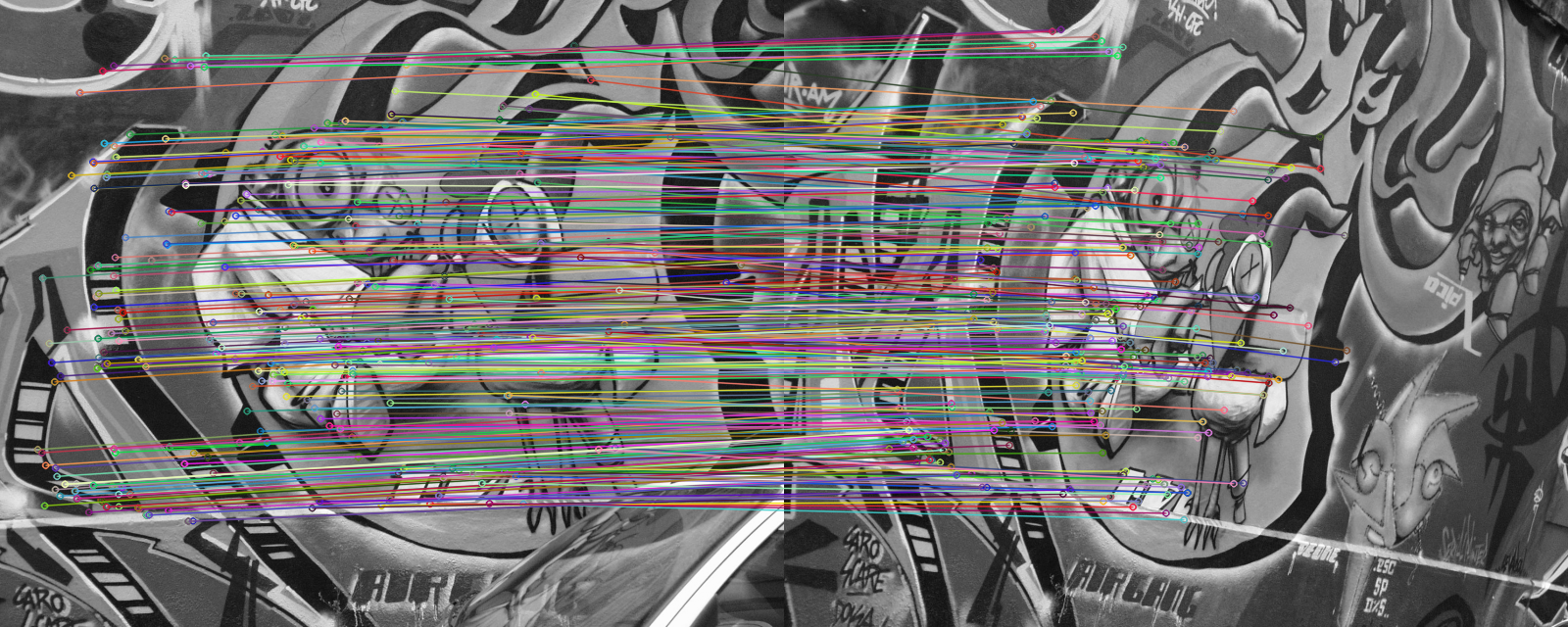
Depending on your OpenCV version, you should get results coherent with:
Keypoints 1:   2943
Keypoints 2:   3511
Matches:       447
Inliers:       308
Inlier Ratio: 0.689038