

DNN-based face detection and recognition#
Check the corresponding tutorial for more details.
Classes#
Name |
Description |
|---|---|
DNN-based face detector. |
|
DNN-based face recognizer. |
Class cv::FaceDetectorYN#
DNN-based face detector.
#include <opencv2/objdetect/face.hpp>Collaboration diagram for cv::FaceDetectorYN:
Detailed Description#
-
class FaceDetectorYN#
DNN-based face detector.
model download link: opencv/opencv_zoo
Constructor & Destructor Documentation#
~FaceDetectorYN()#
Member Function Documentation#
detect()#
int cv::FaceDetectorYN::detect(
InputArray image,
OutputArray faces )
Python:
cv.FaceDetectorYN.detect(image[, faces]) -> retval, faces
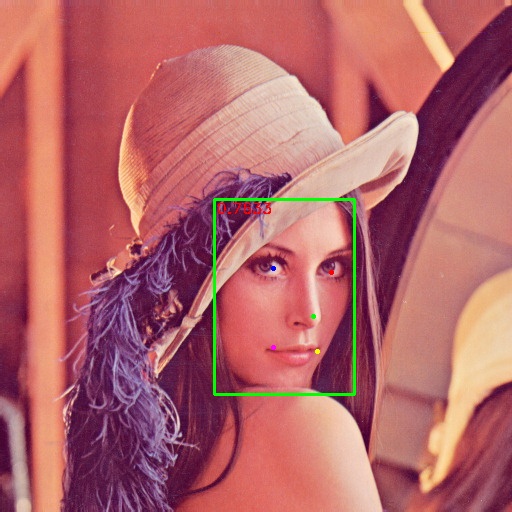
Detects faces in the input image. Following is an example output.
Parameters
image— an image to detectfaces— detection results stored in a 2D cv::Mat of shape [num_faces, 15]0-1: x, y of bbox top left corner
2-3: width, height of bbox
4-5: x, y of right eye (blue point in the example image)
6-7: x, y of left eye (red point in the example image)
8-9: x, y of nose tip (green point in the example image)
10-11: x, y of right corner of mouth (pink point in the example image)
12-13: x, y of left corner of mouth (yellow point in the example image)
14: face score
getInputSize()#
Size cv::FaceDetectorYN::getInputSize()
Python:
cv.FaceDetectorYN.getInputSize() -> retval
getNMSThreshold()#
float cv::FaceDetectorYN::getNMSThreshold()
Python:
cv.FaceDetectorYN.getNMSThreshold() -> retval
getScoreThreshold()#
float cv::FaceDetectorYN::getScoreThreshold()
Python:
cv.FaceDetectorYN.getScoreThreshold() -> retval
getTopK()#
int cv::FaceDetectorYN::getTopK()
Python:
cv.FaceDetectorYN.getTopK() -> retval
setInputSize()#
void cv::FaceDetectorYN::setInputSize(const Size & input_size)
Python:
cv.FaceDetectorYN.setInputSize(input_size)
Set the size for the network input, which overwrites the input size of creating model. Call this method when the size of input image does not match the input size when creating model.
Parameters
input_size— the size of the input image
setNMSThreshold()#
void cv::FaceDetectorYN::setNMSThreshold(float nms_threshold)
Python:
cv.FaceDetectorYN.setNMSThreshold(nms_threshold)
Set the Non-maximum-suppression threshold to suppress bounding boxes that have IoU greater than the given value.
Parameters
nms_threshold— threshold for NMS operation
setScoreThreshold()#
void cv::FaceDetectorYN::setScoreThreshold(float score_threshold)
Python:
cv.FaceDetectorYN.setScoreThreshold(score_threshold)
Set the score threshold to filter out bounding boxes of score less than the given value.
Parameters
score_threshold— threshold for filtering out bounding boxes
setTopK()#
void cv::FaceDetectorYN::setTopK(int top_k)
Python:
cv.FaceDetectorYN.setTopK(top_k)
Set the number of bounding boxes preserved before NMS.
Parameters
top_k— the number of bounding boxes to preserve from top rank based on score
create()#
static Ptr< FaceDetectorYN > cv::FaceDetectorYN::create(
const String & framework,
const std::vector< uchar > & bufferModel,
const std::vector< uchar > & bufferConfig,
const Size & input_size,
float score_threshold = 0.9f,
float nms_threshold = 0.3f,
int top_k = 5000,
int backend_id = 0,
int target_id = 0 )
Python:
cv.FaceDetectorYN.create(model, config, input_size[, score_threshold[, nms_threshold[, top_k[, backend_id[, target_id]]]]]) -> retval
cv.FaceDetectorYN.create(framework, bufferModel, bufferConfig, input_size[, score_threshold[, nms_threshold[, top_k[, backend_id[, target_id]]]]]) -> retval
cv.FaceDetectorYN_create(model, config, input_size[, score_threshold[, nms_threshold[, top_k[, backend_id[, target_id]]]]]) -> retval
cv.FaceDetectorYN_create(framework, bufferModel, bufferConfig, input_size[, score_threshold[, nms_threshold[, top_k[, backend_id[, target_id]]]]]) -> retval
This is an overloaded member function, provided for convenience. It differs from the above function only in what argument(s) it accepts.
Parameters
framework— Name of origin frameworkbufferModel— A buffer with a content of binary file with weightsbufferConfig— A buffer with a content of text file contains network configurationinput_size— the size of the input imagescore_threshold— the threshold to filter out bounding boxes of score smaller than the given valuenms_threshold— the threshold to suppress bounding boxes of IoU bigger than the given valuetop_k— keep top K bboxes before NMSbackend_id— the id of backendtarget_id— the id of target device
create()#
static Ptr< FaceDetectorYN > cv::FaceDetectorYN::create(
CV_WRAP_FILE_PATH const String & model,
CV_WRAP_FILE_PATH const String & config,
const Size & input_size,
float score_threshold = 0.9f,
float nms_threshold = 0.3f,
int top_k = 5000,
int backend_id = 0,
int target_id = 0 )
Python:
cv.FaceDetectorYN.create(model, config, input_size[, score_threshold[, nms_threshold[, top_k[, backend_id[, target_id]]]]]) -> retval
cv.FaceDetectorYN.create(framework, bufferModel, bufferConfig, input_size[, score_threshold[, nms_threshold[, top_k[, backend_id[, target_id]]]]]) -> retval
cv.FaceDetectorYN_create(model, config, input_size[, score_threshold[, nms_threshold[, top_k[, backend_id[, target_id]]]]]) -> retval
cv.FaceDetectorYN_create(framework, bufferModel, bufferConfig, input_size[, score_threshold[, nms_threshold[, top_k[, backend_id[, target_id]]]]]) -> retval
Creates an instance of face detector class with given parameters.
Parameters
model— the path to the requested modelconfig— the path to the config file for compatibility, which is not requested for ONNX modelsinput_size— the size of the input imagescore_threshold— the threshold to filter out bounding boxes of score smaller than the given valuenms_threshold— the threshold to suppress bounding boxes of IoU bigger than the given valuetop_k— keep top K bboxes before NMSbackend_id— the id of backendtarget_id— the id of target device
Source file#
The documentation for this class was generated from the following file:
opencv2/objdetect/face.hpp
Class cv::FaceRecognizerSF#
DNN-based face recognizer.
#include <opencv2/objdetect/face.hpp>Collaboration diagram for cv::FaceRecognizerSF:
Public Types#
Definition of distance used for calculating the distance between two face features.
enum DisType {
    FR_COSINE =0,
    FR_NORM_L2 =1
}
Detailed Description#
-
class FaceRecognizerSF#
DNN-based face recognizer.
model download link: opencv/opencv_zoo
Member Enumeration Documentation#
enum DisType
Definition of distance used for calculating the distance between two face features.
|
|
Constructor & Destructor Documentation#
~FaceRecognizerSF()#
Member Function Documentation#
alignCrop()#
void cv::FaceRecognizerSF::alignCrop(
InputArray src_img,
InputArray face_box,
OutputArray aligned_img )
Python:
cv.FaceRecognizerSF.alignCrop(src_img, face_box[, aligned_img]) -> aligned_img
Aligns detected face with the source input image and crops it.
Parameters
src_img— input imageface_box— the detected face result from the input imagealigned_img— output aligned image
feature()#
void cv::FaceRecognizerSF::feature(
InputArray aligned_img,
OutputArray face_feature )
Python:
cv.FaceRecognizerSF.feature(aligned_img[, face_feature]) -> face_feature
Extracts face feature from aligned image.
Parameters
aligned_img— input aligned imageface_feature— output face feature
match()#
double cv::FaceRecognizerSF::match(
InputArray face_feature1,
InputArray face_feature2,
int dis_type = FaceRecognizerSF::FR_COSINE )
Python:
cv.FaceRecognizerSF.match(face_feature1, face_feature2[, dis_type]) -> retval
Calculates the distance between two face features.
Parameters
face_feature1— the first input featureface_feature2— the second input feature of the same size and the same type as face_feature1dis_type— defines how to calculate the distance between two face features with optional values “FR_COSINE” or “FR_NORM_L2”
create()#
static Ptr< FaceRecognizerSF > cv::FaceRecognizerSF::create(
const String & framework,
const std::vector< uchar > & bufferModel,
const std::vector< uchar > & bufferConfig,
int backend_id = 0,
int target_id = 0 )
Python:
cv.FaceRecognizerSF.create(model, config[, backend_id[, target_id]]) -> retval
cv.FaceRecognizerSF.create(framework, bufferModel, bufferConfig[, backend_id[, target_id]]) -> retval
cv.FaceRecognizerSF_create(model, config[, backend_id[, target_id]]) -> retval
cv.FaceRecognizerSF_create(framework, bufferModel, bufferConfig[, backend_id[, target_id]]) -> retval
Creates an instance of this class from a buffer containing the model weights and configuration.
Parameters
framework— Name of the framework (ONNX, etc.)bufferModel— A buffer containing the binary model weights.bufferConfig— A buffer containing the network configuration.backend_id— The id of the backend.target_id— The id of the target device.
Returns
A pointer to the created instance of FaceRecognizerSF.
create()#
static Ptr< FaceRecognizerSF > cv::FaceRecognizerSF::create(
CV_WRAP_FILE_PATH const String & model,
CV_WRAP_FILE_PATH const String & config,
int backend_id = 0,
int target_id = 0 )
Python:
cv.FaceRecognizerSF.create(model, config[, backend_id[, target_id]]) -> retval
cv.FaceRecognizerSF.create(framework, bufferModel, bufferConfig[, backend_id[, target_id]]) -> retval
cv.FaceRecognizerSF_create(model, config[, backend_id[, target_id]]) -> retval
cv.FaceRecognizerSF_create(framework, bufferModel, bufferConfig[, backend_id[, target_id]]) -> retval
Creates an instance of this class with given parameters.
Parameters
model— the path of the onnx model used for face recognitionconfig— the path to the config file for compatibility, which is not requested for ONNX modelsbackend_id— the id of backendtarget_id— the id of target device
Source file#
The documentation for this class was generated from the following file:
opencv2/objdetect/face.hpp